
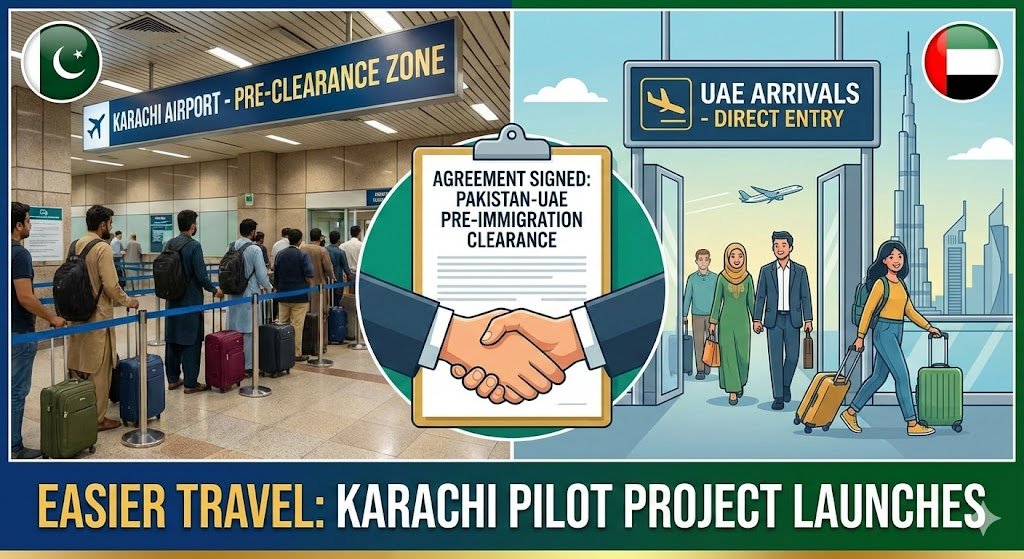

Pakistan and the United Arab Emirates (UAE) are set to sign a landmark agreement on a pre-immigration clearance system designed to facilitate travelers and streamline the immigration process. According to official government sources, this strategic initiative will allow Pakistani passengers to complete all necessary immigration formalities before departure, enabling them to bypass lengthy queues upon arrival at UAE airports and enter the country with the status of domestic passengers. This pilot project, initially launching at Karachi’s Jinnah International Airport, marks a significant milestone in the bilateral relations between the two brotherly nations.
A New Era of Seamless Travel
The decision to formalize this pact was reached during a high-level meeting between Pakistan’s Federal Minister for Interior, Mohsin Naqvi, and a delegation from the UAE led by Ahmed bin Lahij Al Falasi, Director General of Customs and Port Security. The primary objective is to modernize the travel infrastructure between the two countries, utilizing advanced technology to ease the movement of millions of Pakistanis who visit the UAE for employment, business, and tourism.
For decades, the immigration process at major international hubs like Dubai and Abu Dhabi has been a point of bottleneck due to the massive volume of international traffic. By shifting the immigration burden from the destination to the point of origin, both nations aim to optimize airport operations. This means that once a passenger clears the UAE-specific immigration counters at a Pakistani airport, their entry into the Emirates is effectively pre-authorized. Detailed guidelines on general immigration and passport protocols can be found on the Directorate General of Immigration & Passports (DGI&P) website.
- Read More
- Canada Express Entry 2026: What to Expect in the Future
- Mandatory Biometric Entry-Exit at U.S. Border: 2026 Guide
- Romania’s 2026 Labor Quota: 100,000 Work Visas Available
- UAE Visa Strict Exit Rule Enforced for Work Permits
- Portugal’s Citizenship Game Changer: 5-Year Count Starts at Application
The Karachi Pilot Project: A Testing Ground
The government has identified Karachi as the starting point for this initiative. As the commercial hub of Pakistan and a primary gateway for UAE-bound flights, Jinnah International Airport (KHI) provides the necessary infrastructure to test the technical and administrative framework of the pact. Karachi handles a vast majority of the labor force moving to the Gulf, making it the most impactful location for a trial run.
Following the successful implementation in Karachi, the Ministry of Interior plans to expand the facility to other major international airports, including Islamabad and Lahore. This phased rollout ensures that any technical glitches in data sharing or biometric verification are resolved before the system is scaled nationwide. The Federal Investigation Agency (FIA), which oversees immigration in Pakistan, will lead the operational execution alongside UAE officials to ensure international standards are met.
Learning from the “Road to Makkah” Success
The conceptual framework for this agreement is heavily inspired by the “Road to Makkah” project implemented with Saudi Arabia. That initiative has already proven highly successful, allowing thousands of Pakistani Hajj pilgrims to complete their Saudi immigration in Pakistan. The government’s goal is to institutionalize this convenience for all travelers, not just those on religious pilgrimages.
Minister Mohsin Naqvi emphasized that replicating this model for regular commercial travel to the UAE is a priority for the current administration. It not only saves time but also preserves the dignity of Pakistani travelers, ensuring they are not subjected to long wait times after a tiring flight. The UAE Official Government Portal provides additional context on how pre-clearance facilities (such as the US pre-clearance in Abu Dhabi) have successfully transformed traveler experiences globally.
Strengthening Economic and Diplomatic Ties
The UAE is a vital economic partner for Pakistan, housing over 1.5 million Pakistani nationals who contribute billions of dollars in remittances annually. Facilitating the movement of these workers is crucial for maintaining a steady economic pipeline. For those seeking information on work permits and labor regulations in the Emirates, the Ministry of Human Resources & Emiratisation (MoHRE) offers comprehensive official resources.
Moreover, this agreement signals a high level of trust between the security agencies of both nations. Implementing pre-clearance requires the real-time sharing of sensitive immigration and security data. The Federal Authority for Identity, Citizenship, Customs & Port Security (ICP) of the UAE will be central to this digital integration, managing the flow of data between Karachi and UAE arrival ports.
Technological Integration and Security
The pre-clearance process involves advanced biometric systems and digital verification tools. UAE immigration officials will work alongside Pakistani authorities to ensure that every traveler meets the entry requirements of the Emirates before they board the aircraft. This includes scanning passports, capturing biometrics, and verifying visa validity in real-time through the GDRFA Dubai or ICP systems.
From a security perspective, this system allows for a “layered” approach. Potential security risks can be identified and mitigated at the point of origin, making the flight itself more secure. For the traveler, the experience is transformed into a “walk-through” arrival. Upon landing, they can proceed directly to baggage claim and exit the airport, bypassing the standard immigration halls entirely.
Future Outlook: Beyond Karachi
As 2026 begins, the focus remains on the rapid deployment of this system. The Ministry of Interior and the UAE delegation have agreed to finalize the technical protocols within the coming weeks. For official updates on visa types and attestation services, travelers can refer to the UAE Ministry of Foreign Affairs (MoFA).
This initiative is a testament to the government’s commitment to providing better services to its citizens abroad. By leveraging technology and strong diplomatic ties, Pakistan and the UAE are setting a regional standard for immigration management and traveler facilitation. The ultimate goal is a future where travel between these two brotherly nations is as seamless as a domestic flight, fostering greater cultural and economic exchange.