
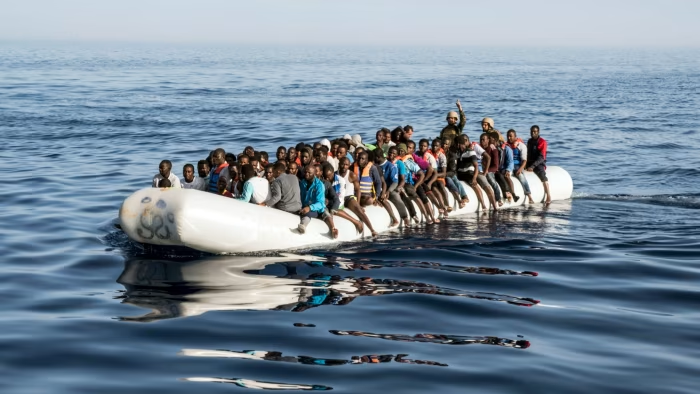

Italy’s system for International Protection is the legal gateway for those fleeing persecution or serious harm. Governed by the Italian Ministry of the Interior and the Geneva Convention (1951), the process is free of charge and focuses on a rigorous, step-by-step documentation of an applicant’s claim.
The Application Background: Fear of Harm
Italy’s system for International Protection is the legal gateway for those fleeing persecution or serious harm. Governed by the Italian Ministry of the Interior and the Geneva Convention (1951), the process is free of charge and focuses on a rigorous, step-by-step documentation of an applicant’s claim.
The system is designed for non-EU nationals and stateless persons who can prove a genuine fear of persecution or face a real risk of serious harm if returned to their country of origin. This risk must be due to factors like race, religion, nationality, social group, political opinion, or indiscriminate violence from armed conflict. The process guarantees the fundamental right to remain in Italy until a final decision is reached.
Who, Where, and How to Apply (The Logistics)
Who Can Apply:
Any adult non-EU national, regardless of their entry status (at the border, in transit, or already in the territory), can submit a request. Parents applying include their minor children present in Italy. Unaccompanied minors can apply with the assistance of a legal guardian or supervisor.
Where to Apply (The Offices):
The request for protection must be made to the Police authorities:
- Border Police Station (Polizia di Frontiera): Immediately upon arrival at a port, airport, or land border.
- Immigration Office (Ufficio Immigrazione) of the Provincial Police Headquarters (Questura): If already present on Italian territory.
- Read also
- Portugal’s Citizenship Path Doubles: New Law Extends Residency to 10 Years
- Spain: How to take Legal Residency via the Arraigo Program
- How to get a Swedish Schengen Visa (90-Day Visitor)
- Sweden : Your Guide to the Job Seeker or Startup Visa/Permit
Fees:
The application procedure for International Protection is a legal right and is free of charge. Applicants are not required to pay any fee for submitting or assessing their request.

The Role of the C3 Form and Biometrics
The process begins with two critical steps:
- Identification (Fotosegnalamento): The police record personal information, take photographs, and fingerprint any applicant aged 14 or older. These fingerprints are entered into the EURODAC database to determine if another European country is responsible for examining the application under the Dublin III Regulation.
- Formal Registration (The C3 Form): This is the official step of formalizing the application. The applicant, assisted by an interpreter, completes the Modello C3 (C3 Form). This detailed form records:
- Identity and Family Details: Personal information, family members, education, religion, and languages spoken.
- Journey Details: The exact route taken to reach Italy.
- The Claim: A brief account of why the applicant left their country and why they fear returning.
Applicants can (and should) submit a written statement in their own language along with the C3 Form to provide a more detailed narrative. Once the C3 Form is signed and submitted, the applicant receives a copy and a temporary permit of stay as an asylum seeker, which is valid for six months and grants the right to work after 60 days from issuance.
The Decision: Territorial Commission and Forms of Protection
The application is then sent to the Territorial Commission for International Protection.
- The Interview: The applicant is notified of the date for a personal, confidential interview. This is the most crucial stage, where the applicant is given the opportunity to tell their story in detail and present any supporting documents (e.g., medical reports, personal correspondence, newspaper articles). The interview is transcribed into a verbale (minutes), which the applicant must review and sign.
- The Decision: The Commission issues a decision granting one of the three forms of protection, or rejecting the claim.
The Special Protection status, in particular, is granted if removing the person would violate Italy’s constitutional or international human rights obligations, such as the right to private and family life, and is assessed based on the seriousness of the ties the person has developed in Italy.