
In a significant development that will bring relief to thousands of Swedish expatriates and their international families, the Swedish Migration Agency (Migrationsverket) has successfully reduced the processing times for specific family reunification cases by more than half. New data released in November 2025 indicates that the agonizing wait for returning Swedish citizens hoping to bring their non-EU spouses and children back to Sweden has been drastically curtailed, signaling a major efficiency shift in how the Scandinavian nation handles residence permits.
This dramatic improvement comes as a direct result of the agency’s digitalization efforts and a strategic restructuring of case management, aiming to prioritize complete applications and reduce the backlog that plagued the system in previous years.
- Read more:-
- Sweden’s Skilled Exodus: Why Doctors are Denied Residency Despite Having Jobs
- Sweden’s repatriation grant will be increased on January 1, 2026—With Strict New Measures to Combat Fraud1
- Swe2den is Introducing Stricter Rules for Family Immigration
- How to get a Swedish Schengen Visa (90-Day Visitor)
- Sweden : Your Guide to the Job Seeker or Startup Visa/Permit
The New Timeline: From Years to Months
For years, one of the most contentious issues in Swedish migration policy was the excessive waiting time for “relations-based” residence permits. Historically, Swedish citizens living abroad who wished to move back to Sweden with a non-EU partner faced waiting periods averaging 12 to 18 months, and in some complex cases, up to two years.
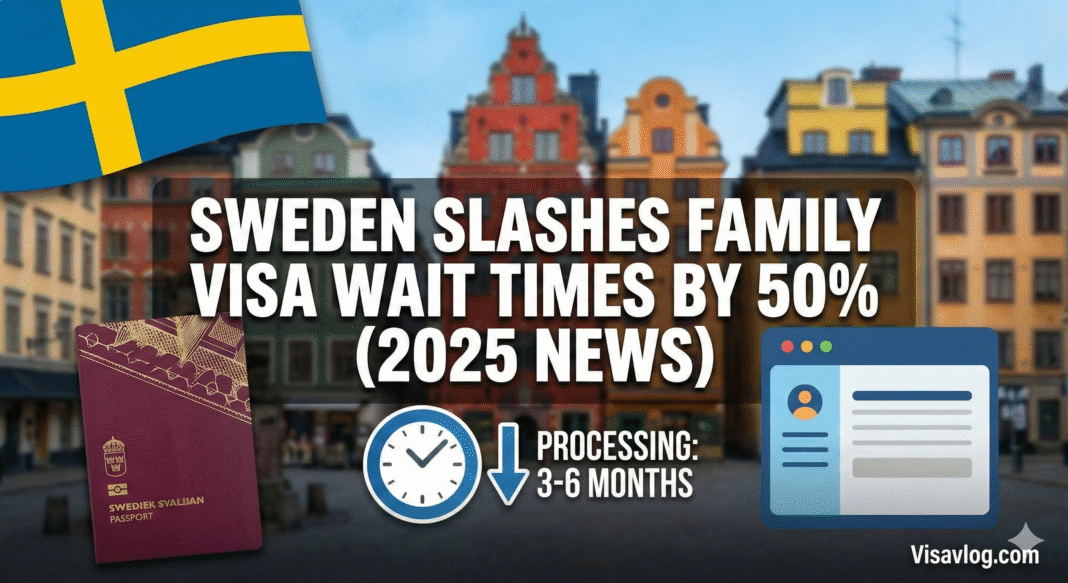
According to the latest statistics available on the Swedish Migration Agency’s official portal, Time to a decision, the processing time for well-documented applications has now plummeted. Many applicants are receiving decisions within 3 to 6 months, a stark contrast to the timelines seen just a year ago.
This efficiency drive focuses heavily on “returning Swedes”—citizens who have established lives abroad but wish to repatriate. The agency has recognized that these cases often involve straightforward verification of citizenship and relationships, allowing for faster adjudication if the “Maintenance Requirement” is clearly met.
Drivers of Change: Digitalization and New Units
The reduction in waiting times is not accidental. It follows a directive from the Swedish Government (Regeringen) to streamline legal migration routes while simultaneously tightening asylum regulations.
In late 2024 and throughout 2025, Migrationsverket implemented a new “digital-first” sorting system. This system uses automated checks to verify the completeness of an application the moment it is submitted. Applications that include all necessary documents—such as passport copies, marriage certificates, and proof of housing—are now fast-tracked to decision-makers.
Furthermore, specific units have been tasked solely with handling family reunification cases, separating them from the more complex asylum caseloads. This specialization has allowed case officers to process standard applications at record speed.
The “Maintenance Requirement” Remains the Key Hurdle
While the speed of processing has improved, the strictness of the rules remains high. It is crucial for applicants to understand that a faster rejection is also a possibility if the requirements are not met.
The most critical factor remains the Maintenance Requirement (Försörjningskravet). As detailed in the official legal guidance Maintenance requirement for family members, the sponsor (the Swedish citizen or resident) must prove two things:
- Housing: They must have a home of sufficient size and standard for the family (e.g., a family of two adults and two children requires a home with at least 3 rooms and a kitchen).
- Income: They must show a regular, work-related income that covers the housing costs plus a standard amount for living expenses after rent is paid.
For 2025, the standard amount for “normal amounts” (disposable income left after rent) has been adjusted for inflation. Applicants are urged to check the latest figures on the Migrationsverket website before applying to ensure they meet the financial threshold.
Exceptions for Returning Citizens
A vital detail that often confuses applicants is the “returning citizen” rule. Generally, the maintenance requirement dictates that the sponsor must have the job and house before the partner arrives. However, for Swedish citizens who have lived abroad for a long period and are returning together with their family, there is often more flexibility regarding the timing of securing employment, provided they can demonstrate “well-established” relationships and sufficient capital or employability.
The Swedish Ministry of Justice has emphasized that while the country is taking a harder line on irregular migration, it aims to be attractive to high-skilled labor and returning nationals. The improvements in processing times are part of this strategy to ensure that Sweden does not lose its own citizens due to bureaucratic hurdles.
Tips for Applicants to Ensure Speed
To benefit from these reduced waiting times, applicants must avoid the “supplementation queue.” If an application is incomplete, it is paused and sent to a slower queue until the officer requests missing documents.
Official advice for a smooth application:
- Apply Online: Paper applications are processed much slower. Always use the e-service.
- Upload Everything: Do not wait for the case officer to ask for your marriage certificate or children’s birth certificates. Upload them immediately.
- Power of Attorney: If the sponsor in Sweden needs to talk to the agency on behalf of the applicant abroad, ensure a Power of Attorney form is signed and uploaded.
- Check Passports: Ensure the non-EU family member’s passport is valid for the duration of the intended permit.
Broader European Context
This move places Sweden in a competitive position compared to other European nations. While the UK is currently debating extending settlement routes to 10 years and increasing income thresholds drastically, Sweden’s move to cut processing times for families signals a willingness to welcome back its diaspora.
However, prospective movers should be aware of the “Paradigm Shift” in Swedish politics. While family processing is faster, the government is simultaneously investigating tighter rules for permanent residency and citizenship, potentially introducing language tests and civics exams in late 2025 or 2026.
Conclusion
The reduction of waiting times by over 50% is a massive win for families who have been living in limbo. It restores a degree of predictability to the migration process. However, this speed relies heavily on the applicant’s ability to submit a “perfect” application. For those preparing to move to Sweden, the message is clear: the door is opening faster, but the requirements to walk through it are as strict as ever.
For the most accurate and personalized information, always refer to the official portal: www.migrationsverket.se.