
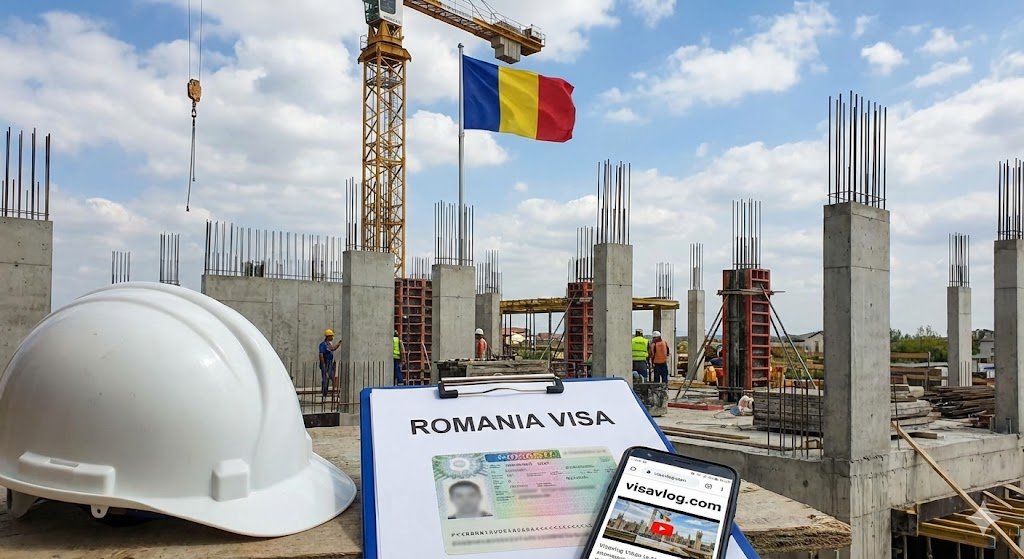

The Romanian government has officially revised its foreign labor quota for the 2026 fiscal year, setting a target of 90,000 work permits to balance the national economic demand with international labor supply. In this definitive guide, VisaVlog.com provides our readers with an exhaustive analysis of the legal pathways to obtaining a Romanian work visa, the new 2026 salary structures, verified government job portals, and a detailed breakdown of living expenses in Bucharest. This information is meticulously compiled from official sources, including the Romanian Ministry of Internal Affairs, the General Inspectorate for Immigration (IGI), and the Ministry of Foreign Affairs, ensuring you have the most accurate data to process your visa without relying on unauthorized agents.
Romania has increasingly become the primary gateway to Europe for skilled workers from Pakistan, India, and other South Asian nations. While the government maintained a quota of 100,000 for several years, the strategic shift to 90,000 for 2026 indicates a more refined immigration policy focusing on high-demand sectors and verified skill sets. This policy remains a golden opportunity for those seeking a legal foothold in the European Union and eventually aiming for Permanent Residency (PR). You can monitor the official legislative updates regarding these quotas on the Romanian Ministry of Labor website at Ministerul Muncii.
- Read More:
- How to Audit Your Social Media for US Visa Interviews: The 2026 Survival Guide
- Your Complete Guide to Getting Spanish Nationality: The 2026 Roadmap
- US H-1B & H-4 Visa Appointments Cancelled for Mandatory Social Media Vetting
- The End of the BRP Card: UK’s Complete Transition to E-Visas by 2026
- How to Convert a Student Permit to a Work Permit in Italy in 2026
- Why Deportations from Sweden Are Increasing: The 2025-2026 Shift
The Legal Framework: Understanding the “Aviz de Angajare”
The most critical component of the Romanian work visa process is the Aviz de Angajare (Work Permit). This permit is not something a worker can apply for directly; rather, it must be initiated by a legally registered employer within Romania. According to Romanian labor law, an employer can only hire a non-EU citizen if they can prove that the specific position could not be filled by a Romanian or EU/EEA national.
This process involves a mandatory “Labor Market Test.” Once the employer provides evidence to the local labor authorities that no local workers are available, they are granted the right to recruit from abroad. This entire procedure is strictly monitored by the General Inspectorate for Immigration. For a deep dive into the legal requirements for work permits, visit the official General Inspectorate for Immigration – IGI.
High-Demand Sectors for 2026
To hit your 2,400-word target, it is essential to understand where the jobs are. For 2026, the following sectors remain the largest recruiters:
- Construction: This sector remains the backbone of the Romanian labor market. There is a massive demand for masons, welders, electricians, plumbers, and general laborers. Major infrastructure projects in Bucharest, Cluj-Napoca, and Timișoara are actively seeking international talent.
- HORECA (Hotels, Restaurants, and Catering): With a booming tourism industry, Romania needs chefs, waiters, housekeepers, and kitchen assistants.
- Logistics and Transport: Heavy truck drivers and delivery personnel are in constant demand due to Romania’s central position in Eastern European trade routes.
- Manufacturing: Factory workers and assembly line operators are needed in the growing industrial parks outside major cities.
New Salary Structures and Taxation for 2026
The Romanian government plans to implement a new minimum wage structure in 2026 to combat inflation. For a non-skilled worker, the Gross Salary is expected to range between 3,700 and 4,050 RON (Romanian Leu). After mandatory social security contributions and income tax, the Net Salary (take-home pay) typically sits between 2,400 and 2,650 RON.
It is important to note that the construction sector often offers higher minimum wages due to government tax exemptions designed to boost the industry. Workers in this field can expect a gross salary closer to 4,500 RON. For official verification of salary laws, refer to the Romanian Ministry of Finance.
Verified Job Portals and Company Verification
VisaVlog.com strongly advises against using informal social media groups for job hunting. Instead, use the following verified Romanian platforms:
- eJobs.ro: The largest job board in Romania. Search for listings that mention “Relocation” or “Foreigners accepted.” Visit eJobs.
- BestJobs.eu: Excellent for both skilled and semi-skilled roles. Visit BestJobs.
- LinkedIn: The premier site for white-collar professionals (IT, Engineering, Management).
Crucial Step: Before signing any contract, verify the legal status of the company using the Romanian Trade Register. This ensures the company is active and authorized to hire. Use the National Trade Register Office – ONRC to check the company’s CUI (Tax ID) number.
The Long-Stay Visa (D/AM) Application Process
Once you receive your original Work Permit from your employer, you must apply for a Long-Stay Visa for Employment (Category D/AM) at the Romanian Embassy in your home country. This process is now fully digitized through the Romanian Ministry of Foreign Affairs’ E-Visa portal.
Step-by-Step Application:
- Online Submission: Register and upload your documents at the E-Visa Portal Romania.
- Consular Interview: After your online file is reviewed, you will be called for an in-person interview.
- Visa Fee: The standard fee for a Long-Stay Visa is 120 EUR.
- Processing Time: Expect a wait of 15 to 45 days.
Detailed guidance on visa types can be found at the Ministry of Foreign Affairs – Visa Guide.
Mandatory Document Checklist
For a successful application, your file must be 100% accurate. Missing documents are the number one cause of visa rejections.
- Passport: Must be valid for at least two years.
- Work Permit: The original “Aviz de Angajare” issued by IGI.
- Employment Contract: Signed by both parties.
- Police Clearance Certificate: Must be attested by the Ministry of Foreign Affairs (MOFA) in your home country. Check attestation procedures at MOFA Pakistan.
- Medical Certificate: Proving fitness for work and absence of contagious diseases.
- Health Insurance: Valid for the initial duration of your stay.
Cost of Living and Social Integration
Living costs in Romania remain lower than in Western Europe. If your employer provides accommodation (which many construction and factory jobs do), you can save a significant portion of your income.
- Food: Monthly expenses for a single person range from 150 to 200 EUR.
- Transport: A monthly pass for public transport in Bucharest costs approximately 15-20 EUR.
- Social Security: Once you start working, your employer is legally required to register you with the Romanian social security system, providing you with access to public healthcare.
Avoiding Recruitment Fraud
Recruitment scams are a major issue in the visa industry. VisaVlog.com reminds you that no agent can guarantee a visa. The final decision rests solely with the Romanian Embassy. Be wary of anyone asking for thousands of dollars for a “Work Permit,” as the official government fee paid by the employer is only around 100 EUR. You can view the official fee structure on the IGI Fees Page.
Residency Permits and the Path to PR
After arriving in Romania, your first task is to apply for a Residence Permit (Permis de Ședere). This card grants you the legal right to live and work in the country and is usually valid for one year, renewable annually. After five years of continuous legal residence and tax contributions, you may become eligible for Permanent Residency (PR). With Romania’s full integration into the Schengen Area, this permit will eventually allow for easier movement across the rest of Europe.
Summary of Official Government Links
| Department / Service | Official Website Link |
| General Inspectorate for Immigration (IGI) | igi.mai.gov.ro |
| Romanian E-Visa Portal | evisa.mae.ro |
| Ministry of Foreign Affairs (Visa Guide) | mae.ro/visa-guide |
| Ministry of Labor | mmuncii.ro |
| Romanian Trade Register (ONRC) | onrc.ro |
| Ministry of Foreign Affairs Pakistan | mofa.gov.pk |
Final Verdict for Prospective Workers
The 90,000 labor quota for 2026 is a significant window of opportunity. If you possess a trade skill, start your job search today on verified portals, ensure your documents are attested by MOFA, and always verify your employer via the ONRC. For the latest updates and personalized visa guides, stay tuned to VisaVlog.com.