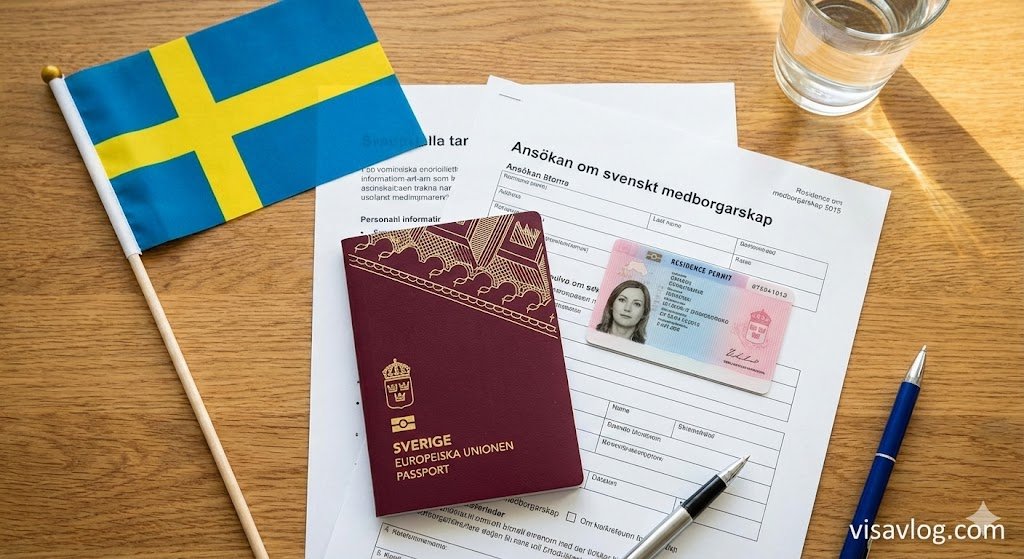
Sweden is one of the most attractive countries for long-term settlement. However, the path to the “yellow and blue” passport depends entirely on how you entered the country. A PhD student has a very different timeline than a seasonal farm worker.
Currently, the standard waiting time is 5 years, but the Swedish government has proposed increasing this to 8 years for new applicants starting potentially in June 2026.
Below is the detailed breakdown for each category of worker and resident.
1. The Core Requirement: Permanent Residence First
- To successfully become a Swedish citizen, you must first understand the fundamental order of the process: obtaining a Permanent Residence Permit (PUT) is an absolute prerequisite. It is legally impossible to apply for citizenship while you are still holding a temporary residence permit, such as a standard two-year work permit or a student visa. The journey is a step-by-step progression: first, you live in Sweden on temporary permits; next, you secure your permanent residence status (typically after four years); and finally, once you have met the total time requirement, you may apply for naturalization.
- To qualify for Swedish citizenship in 2026, applicants must satisfy a strict set of criteria verified by the authorities. The first and most critical step is proving your identity. In almost all cases, this requires submitting a valid, original passport from your home country. Without verified identity documents, the application cannot proceed.
- Secondly, you must meet the specific residence time requirements. The general rule is that you must have lived in Sweden for a continuous period of five years with a valid permit. However, there are exceptions that can shorten this time. For example, if you are married to or completely cohabiting with a Swedish citizen, the waiting period is reduced to three years, provided you have lived together for the past two years.
- Thirdly, the Swedish Migration Agency conducts a thorough check on your “good conduct.” This means you must have led a law-abiding life in Sweden. You must not have a criminal record, and strictly, you must not have any outstanding debts or unpaid fines registered with the Swedish Enforcement Authority (Kronofogden). Financial stability and legal standing are viewed as indicators of your integration into society.
- Finally, applicants looking toward 2026 must be prepared for stricter integration requirements that are expected to be fully implemented. Under these proposed rules, simply living in Sweden may no longer be enough. Applicants will likely need to pass a mandatory Swedish language exam to prove communication skills and complete a civic orientation test regarding Swedish culture and society. Furthermore, there will be a heavier emphasis on self-sufficiency, meaning you must prove that you can support yourself financially and have not relied on social welfare benefits for your upkeep during your residence.
2. Category-by-Category Breakdown
A. “Simple” Workers (Employees)
This category applies to anyone on a standard work permit (e.g., IT, construction, restaurant staff).
- Route: Work Permit ➔ Permanent Residence ➔ Citizenship.
- Time Required: You must work for 4 years (48 months) to get Permanent Residence. Once you have lived in Sweden for 5 years total, you can apply for citizenship.
- Condition: You must have worked continuously and paid all taxes. If you lost your job and had long gaps (more than 6 months), your “clock” might restart.
B. Farmers (Self-Employed & Seasonal)
There are two types of “farmers” in the Swedish system:
- Seasonal Pickers (Berry/Vegetable): These permits are temporary and do not count towards citizenship. You cannot settle in Sweden on this visa.
- Self-Employed Farmers (Business Owners): If you bought a farm or started an agricultural business.
- Requirement: You must own at least 50% of the business.
- Time: You get a 2-year probationary permit. If your business is profitable after 2 years, you get Permanent Residence immediately. You can then apply for citizenship after 5 years of living in Sweden.
- Financials: You must show you have SEK 200,000 in the bank when you apply, plus SEK 100,000 for your spouse.
- Read more:-
- Sweden’s Skilled Exodus: Why Doctors are Denied Residency Despite Having Jobs
- Sweden’s repatriation grant will be increased on January 1, 2026—With Strict New Measures to Combat Fraud1
- Swe2den is Introducing Stricter Rules for Family Immigration
- How to get a Swedish Schengen Visa (90-Day Visitor)
- Sweden : Your Guide to the Job Seeker or Startup Visa/Permit
C. EU Blue Card Holders
This is for highly skilled workers with a university degree and a salary above 1.5x the average gross salary.
- Common Misconception: Time spent on a Blue Card in Germany or France does not count towards Swedish citizenship.
- The Rule: You need 5 years of residence strictly in Sweden.
- Advantage: If you have lived in another EU country for 18 months on a Blue Card, you can move to Sweden without a new visa, but your “Citizenship Clock” starts from zero when you register in Sweden.
D. Researchers & Doctoral Students (PhD)
This is the “Golden Ticket” category. Sweden wants to keep its academics.
- Doctoral Students: Your time studying for a PhD counts 100% towards citizenship.
- Timeline: After 4 years of PhD studies, you can get Permanent Residence. After 5 years total, you become a citizen.
- Guest Researchers: If you are employed by a university for research, your residence counts fully.
E. Bachelor & Master Students
This is the hardest path.
- The Trap: Time spent on a normal Student Permit (Bachelor/Master) does not count towards citizenship.
- The Path:
- Study for 2–3 years (Time = 0 years for citizenship).
- Find a job and switch to a Work Permit.
- Work for 4 years to get Permanent Residence.
- Apply for Citizenship.
- Total Time: Often 6 to 7 years.
F. EU Long-Term Residents (From other EU Countries)
If you have “Long-Term Resident Status” (Daueraufenthalt-EU) from Italy, Spain, etc.:
- Rights: You can move to Sweden more easily than others.
- Citizenship: There is no shortcut. You must still live in Sweden for 5 years to become Swedish. Your time in Italy/Spain does not reduce the wait time.
3. Application Procedure: A to Z
Step 1: Check Eligibility
- Lived in Sweden for 5 years (with Permanent Residence).
- No criminal record (no prison time, no unpaid debts to Kronofogden).
- Identity verified (Valid Passport).
Step 2: Online Application
- Go to the Swedish Migration Agency website.
- Select “Apply for Citizenship”.
- Log in with BankID.
Step 3: Submit Passport
- After you apply online, the Migration Agency will ask you to send your original physical passport by registered mail (REK-brev).
- Warning: They might keep your passport for 6–8 months while processing. Do not plan travel during this time.
Step 4: The Fee
- Here are the specific fee details for each citizenship category
- Standard Citizenship for Adults (Naturalization) For most applicants, including workers, researchers, and self-employed farmers who have lived in Sweden for 5 years (or 3 years if married to a Swedish citizen), the application fee is currently SEK 1,500. However, please note that under the proposed 2026 laws, the government is planning to increase this fee significantly to SEK 2,900 to cover the cost of stricter background checks. This fee applies to all standard applications where you are applying for yourself.
- Citizenship for Children (Notification) If you are applying for a child separately (for example, if the child was born in Sweden to foreign parents or has lived here for 3 years), the fee is much lower because it is processed as a “Notification” (Anmälan). The current fee is SEK 175. However, if a parent is applying for naturalization (the SEK 1,500 route) and includes their minor children in the same application, there is currently no extra fee for the children. Be aware that new proposals for 2026 suggest introducing a separate fee of SEK 475 for children to cover administrative costs.
- Young Adults Aged 18–21 If you came to Sweden as a child and have lived here for a long time, you can use a simplified “Notification” procedure between the ages of 18 and 21 instead of the full adult application. This is faster and cheaper. The fee for this specific category is currently SEK 175. This is an excellent option for students or children of workers who turned 18 recently, as it avoids the higher adult fee and longer processing times.
- Nordic Citizens (Denmark, Finland, Iceland, Norway) Citizens of other Nordic countries have the easiest path to Swedish citizenship. If you have lived in Sweden for at least 5 years (or 2 years in some cases), you can apply via “Notification” rather than naturalization. The fee for this simplified process is currently SEK 175. If you do not meet the notification requirements and must apply via the standard route, the full adult fee of SEK 1,500 applies.
- Stateless Persons and Refugees Sweden provides special fee exemptions for the most vulnerable applicants. If you are a recognized refugee with a status declaration (flyktingstatusförklaring) or a stateless person with a travel document issued by the Swedish Migration Agency, your citizenship application is free of charge (SEK 0). This exemption is designed to help those who cannot easily obtain paid documents from their home countries.
- Adopted Children For children adopted by Swedish citizens, the process is usually handled via “Notification” if the adoption was completed abroad and recognized in Sweden. The fee for this notification is SEK 175. If the child does not automatically acquire citizenship through the adoption process upon arrival, this small fee secures their Swedish passport.
Step 5: The Decision
- Current processing time is 6 to 35 months. It is very slow.
- Once approved, you will receive your certificate.
4. Important: The “New Rules” Warning (2026)
The Swedish government is currently debating a major law change proposed for late 2026.
- Residency: May increase from 5 years to 8 years.
- Language: A mandatory Swedish language test (B1/C1 level) may be introduced.
- Self-Sufficiency: Stricter rules on never having received welfare benefits.
If you are eligible now, you should apply immediately before these tougher rules become law.