
The Japanese government is actively moving to overhaul its immigration and nationality acquisition policies, proposing a significant tightening of the criteria for foreigners seeking to acquire Japanese citizenship (Naturalization). This initiative comes as Japan faces persistent labor shortages, particularly in critical sectors like Agriculture, necessitating a balance between increasing the intake of workers and ensuring long-term integration.
The most notable proposal under consideration for the Comprehensive Policy Package on Foreign Nationals, set to be compiled in January 2026, is the effective extension of the minimum residency period required for nationality, especially for those entering through employment streams like the Specified Skilled Worker (SSW) program.
A. The Proposed Naturalization Shift: 5 Years to 10 Years
Currently, the Japanese Nationality Act (Article 5) states that a foreign national must have continuously maintained a domicile in Japan for at least five consecutive years to be eligible for naturalization. This duration is significantly shorter than the 10 years of residence generally required to obtain Permanent Residency (PR), creating a legal inconsistency that the government now seeks to address.
Core Proposed Change for 2026
While the law itself may not be immediately rewritten, the Justice Ministry is considering revising the screening practices to effectively extend the required period of stable residence from 5 years to 10 years. This move is largely driven by recommendations from government study groups noting that naturalization requirements should be, at minimum, consistent with—or stricter than—those for Permanent Residency.
The impact of this stricter screening is already being felt:
- Stricter Evaluation of Stability: Immigration examiners are now scrutinizing applicants’ employment stability, consistency of income, tax payment history, and social insurance premium payments more carefully. Frequent job changes, long periods of unemployment, or non-payment of taxes/insurance premiums during the five-year period are increasingly leading to rejection, effectively pushing the real minimum requirement toward a longer, more stable tenure.
- Alignment with PR: The move aims to ensure that foreigners seeking the full rights of Japanese citizenship (including suffrage) have demonstrated the same long-term commitment and integration as those seeking permanent status. This alignment is expected to be formalized in the comprehensive policy package scheduled for 2026.
Official Reference: The fundamental naturalization rules are outlined in the Nationality Act (Article 5), published by the Japanese government.
B. Specific Impact on Foreign Farmers and Skilled Workers
The agriculture sector relies heavily on foreign labor, particularly through the Specified Skilled Worker (SSW) system, which the government is relying on to fill significant labor gaps.
The Specified Skilled Worker (SSW) System
Foreign nationals in the Agriculture Industry (which falls under the SSW visa) enter Japan under the following categories:
- SSW (i): Allows work in 16 specified fields (including agriculture) for a total maximum stay of five years. Workers are generally not allowed to bring family members.
- SSW (ii): Designated for occupations requiring advanced skills. This status has no upper limit on the period of stay and permits workers to bring their family members (spouse and children). The agriculture industry is one of the fields now eligible for the SSW (ii) status, providing a path to long-term residency.
The original five-year naturalization path meant an agricultural worker could theoretically apply for citizenship immediately after completing the SSW (i) phase. However, extending the requirement to 10 years forces workers, including foreign farmers, to transition to the SSW (ii) status or another long-term visa before citizenship becomes an option. This ensures a decade of continuous, skilled contribution to the Japanese economy.
Labor Shortage Context for 2026
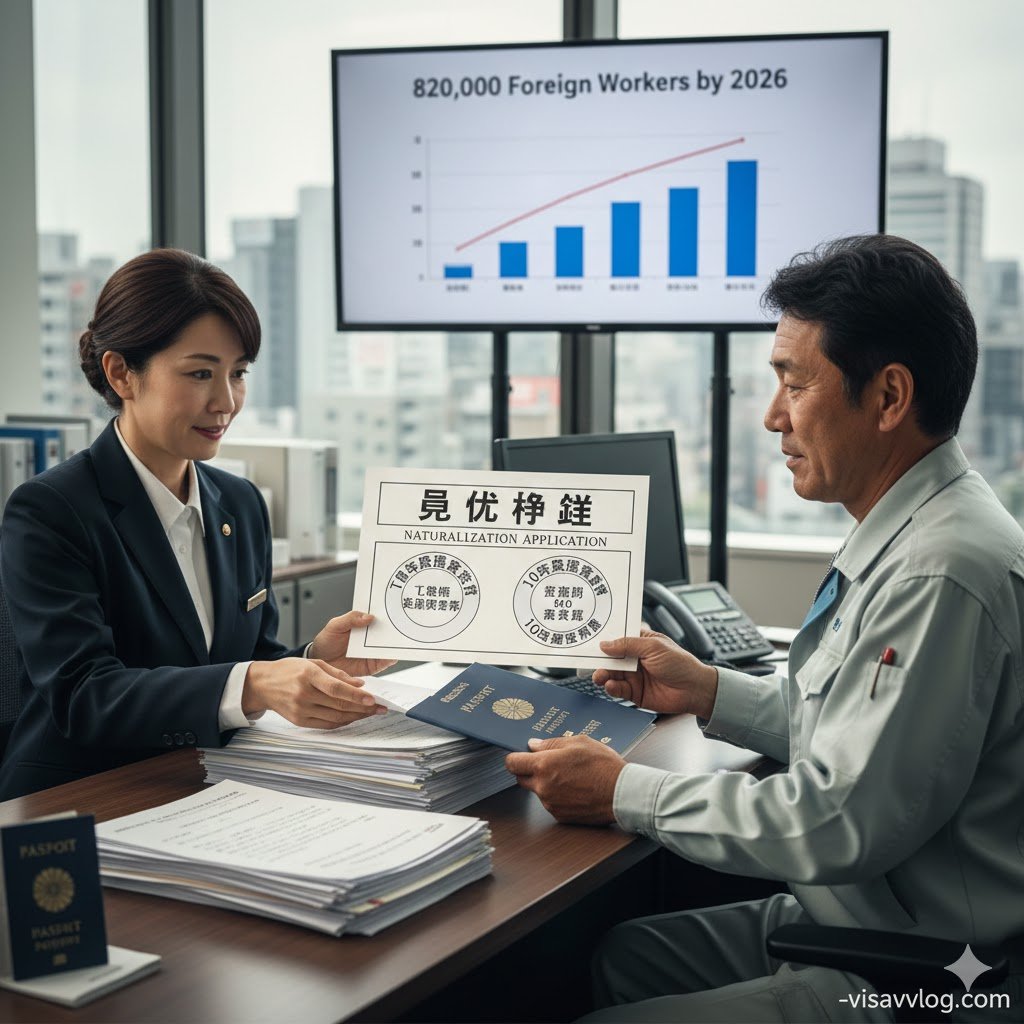
This policy overhaul occurs while Japan is actively attempting to mitigate a severe labor crisis. The government has approved a plan to significantly raise the cap on foreign workers accepted under the SSW program, aiming to welcome up to 820,000 skilled professionals over the five years beginning in fiscal 2024. This massive target highlights Japan’s dependence on foreign labor, even as it tightens the path to citizenship. This data point is crucial in understanding the dichotomy of Japan’s immigration policy in 2026—desperate for labor yet cautious about granting nationality.
C. Fees, Documentation, and the Application Process in 2026
The proposed reforms also include massive increases in application fees related to immigration and nationality, aiming to align Japan’s fees with those of Western nations.
Proposed Fee Hikes (Fiscal 2026)
While not yet final, the Japanese government is reportedly considering:
| Service | Current Fee (Approximate) | Proposed Fee (Approximate) | Source |
| Permanent Residency (Acquisition) | ¥10,000 | Up to ¥300,000 | The Japan Times (Dec 2025) |
| Residential Status Change/Extension | ¥6,000 | Up to ¥100,000 | The Japan Times (Dec 2025) |
The Naturalization Process: A to Z
- Residency Requirement: Applicant must maintain a domicile in Japan for the minimum period (expected to be 10 years for most workers by 2026).
- Age and Capacity: Must be 20 years of age or older and legally competent under their national law.
- Good Conduct: Demonstrated by a clean criminal record and, critically, proper fulfillment of public obligations (e.g., timely payment of tax and social insurance premiums).
- Means of Support: Ability to make a living through the applicant’s own assets or skills, or those of a spouse or relative. This requires submitting documentation of income statements and assets.
- Renunciation of Foreign Nationality: The applicant must, in principle, pledge to give up their current nationality upon acquiring Japanese citizenship, as Japan generally does not permit dual citizenship (Nationality Act, Article 5).
- Submission: The application is submitted to the Ministry of Justice (MOJ) via the regional Legal Affairs Bureau.
- Finalization: Naturalization is effective upon public notice in the Official Gazette by the Minister of Justice.