
The term Carta di Soggiorno (Residence Card) in Italy is often used by non-EU citizens to refer to the long-term residence permit. However, it can technically refer to two distinct documents with different requirements and procedures:
- The Residence Card for Family Members of EU/Italian Citizens (pursuant to Legislative Decree 30/2007, Art. 10 and Art. 17).
- The EU Long-Term Residence Permit (Permesso di Soggiorno UE per Soggiornanti di Lungo Periodo), which is the document that replaced the old “Carta di Soggiorno” for all other non-EU citizens.
This detailed guide focuses on the EU Long-Term Residence Permit (the de facto permanent residency title for non-EU nationals), covering all official requirements, procedures, costs, and typical processing times. All details are based on official government sources, including the Italian Ministry of Interior, the State Police (Polizia di Stato), and the Consolidated Law on Immigration (D.Lgs. 286/1998).
1. The EU Long-Term Residence Permit (Permesso UE)
This document grants permanent status and is the key to long-term stability in Italy, offering rights comparable to Italian citizens in areas like social assistance, healthcare, and education. It has an unlimited duration (though the card itself must be renewed every five years for updated photos and identification data).
A. Essential Requirements and Conditions
To apply for the EU Long-Term Residence Permit, a non-EU citizen must satisfy the following cumulative conditions, as established by Article 9 of the Consolidated Law on Immigration:
I. Duration of Legal Stay
- The applicant must have been residing in Italy legally and continuously for at least five (5) years.
- Absences from Italy are generally permitted, provided they do not exceed six consecutive months or ten months in total over the five-year period.
II. Sufficient Income
- The applicant must demonstrate an annual minimum income that is not lower than the annual amount of the Italian Social Allowance (Assegno Sociale). This is a non-negotiable requirement.
- Note: If the applicant includes dependent family members, the required minimum income increases based on the family unit size (e.g., typically the Assegno Sociale amount plus half the Social Allowance for each dependent).
- Documentation: Income must be proven using official tax returns (Dichiarazione dei Redditi), CUD (Certificazione Unica) forms, and/or consistent pay slips for the required period.
III. Adequate Accommodation (If Applicable)
- If the application includes dependent family members (e.g., for ricongiungimento or family cohesion), the applicant must provide documentation attesting to the availability of suitable accommodation (certificato di idoneità alloggiativa) issued by the local Municipality (Comune).
IV. Italian Language Knowledge
- The applicant must demonstrate a command of the Italian language at a level not lower than A2 of the Common European Framework of Reference for Languages (CEFR).
- Proof: Language proficiency is certified by passing a formal language test (Test di Lingua Italiana) organized by the local Prefectures.
- Exemptions: Those who are minors under 14 years old, those possessing an Italian school diploma (e.g., middle school or higher), or those with certified severe learning disabilities are exempt from taking the test.
V. Absence of Criminal Record
- The applicant must not be deemed a danger to public order or state security. This requires submitting a police clearance certificate (certificato del casellario giudiziale) and a certificate regarding pending criminal proceedings (certificato delle iscrizioni relative ai procedimenti penali).
- Read more:-
- Italy New Immigration for 2026: 150,000 Work Visas
- How to Apply for Italian Work Visa 2026
- Italy is Open to International Student Enrollment
- How to Apply for Asylum in Italy
B. Application Procedure (The Postal Kit)
The application procedure for the EU Long-Term Residence Permit is standard and primarily uses the Italian postal system.
I. Submitting the Application (Kit Postale)
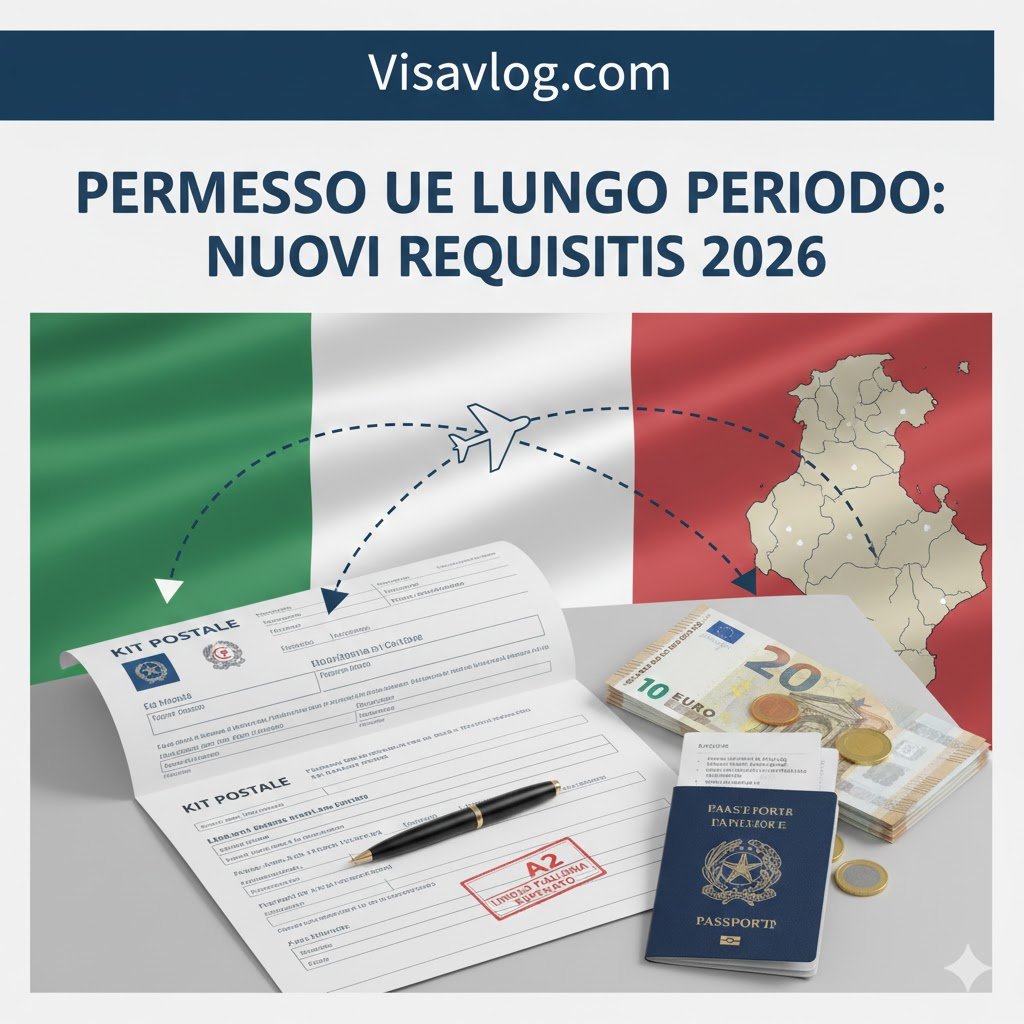
- The application is filed using the special Postal Kit (Kit Postale a banda gialla), which can be retrieved for free from any Post Office “Sportello Amico” (Friend’s Counter) or the Patronati (authorized aid agencies).
- The applicant must complete Modulo 1 and Modulo 2 (if applicable) and enclose all supporting documentation (valid passport, expired permit, income documents, criminal checks) inside the envelope.
- The sealed envelope is submitted at an authorized Post Office.
II. Receipt and Appointment
- Upon submission, the Post Office operator issues a receipt (ricevuta). This receipt is vital as it legally attests to the application’s submission and allows the applicant to check the status of the request online.
- At the same time, or shortly thereafter (via SMS or registered mail), the applicant is notified of the date, time, and location of the appointment at the local Questura (Police Headquarters) for fingerprinting (fotosegnalamento) and verification of the original documents.
III. Biometrics and Issuance
- The applicant attends the Questura appointment for the acquisition of biometric data (photo and fingerprints).
- The Questura then evaluates the documentation and legal requirements.
- If successful, the applicant is notified to return to the Questura for the collection of the electronic Residence Permit (PSE).
C. Fees and Contributions (Current Estimates)
The costs for the EU Long-Term Residence Permit consist of several fixed charges and a mandatory state contribution. These costs are subject to periodic governmental updates.
| Description of Fee | Amount | Detail and Payment Method |
| Duty Stamp (Marca da Bollo) | € 16.00 | Must be purchased from a Tabaccheria and attached to the application kit. |
| Electronic Card Production Cost | € 30.46 | Payment made via pre-marked Postal Payment Slip (C/C Postale n. 67422402). |
| Government Contribution Fee | € 100.00 | Mandatory fee for the Long-Term EU Permit. (Paid via Postal Payment Slip). |
| Postal Service Fee | € 30.00 | Paid directly to the Post Office operator upon submission. |
| Estimated Total Minimum Cost | € 176.46 | Minimum total (excluding costs for translations/legalizations). |
- Note: Minors under the age of 18, and those applying for medical treatment, are exempt from the €100.00 Government Contribution Fee, but must still pay the Marca da Bollo and the production/postal service fees. It is essential to consult the official Immigration Portal Cost Table for the most up-to-date figures.
D. Processing Time (Timelines)
The processing time for the EU Long-Term Residence Permit varies significantly based on the region and the workload of the local Questura.
- Legislative Target: The law states that the request should be finalized within 90 days from the date of submission.
- Actual Timeframes: In reality, processing times often exceed the statutory limit, commonly ranging from 4 to 12 months or even longer, particularly due to the extensive security and income background checks required.
- Temporary Status: The receipt issued by the Post Office serves as the provisional residence title (titolo provvisorio di soggiorno). This receipt allows the applicant to legally stay in Italy and travel within the Schengen Area for up to 90 days per semester, but it does not permit travel to non-Schengen countries (except to return to the applicant’s country of origin for a direct return flight to Italy).
2. The Carta di Soggiorno for EU/Italian Family Members
A separate title, which retains the name Carta di Soggiorno, is issued to non-EU family members of an EU or Italian citizen who has exercised the right of free movement. This is governed by Legislative Decree 30/2007.
- Initial Card (5 Years): Upon entry and registration, the non-EU family member is issued a Residence Card valid for five (5) years.
- Permanent Card (Unlimited): After five years of continuous legal stay in Italy, and provided the core requirements (such as family bond or dependency) still exist, the non-EU family member acquires the right to permanent residence. They can then request the Permanent Residence Card (known as Carta di Soggiorno permanente).
- Procedure: Applications for EU family members can often be submitted directly at the local Questura or, in some areas, via the Postal Kit. The costs are lower, generally limited to the €16.00 Marca da Bollo and the €30.46 card production fee.