
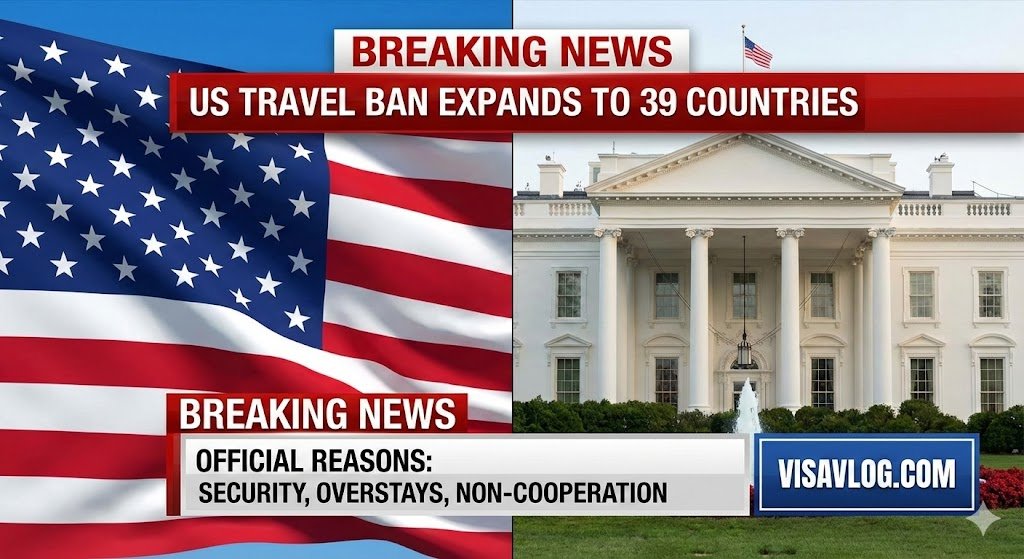
The United States government has officially expanded its travel restrictions to include a total of 39 nations, citing severe deficiencies in global security cooperation and identity management. On December 16, 2025, President Donald Trump signed a significant Presidential Proclamation that widens the scope of the initial restrictions established earlier in the year. This new directive, which fully takes effect on January 1, 2026, imposes a full suspension of entry on nationals from 19 countries and places partial visa restrictions on 20 others. This decisive move is based on an extensive review by the Department of Homeland Security (DHS) and the Department of State, aimed at protecting U.S. borders from terrorism, high visa overstay rates, and uncooperative foreign governments.
The Scope of the 2026 Travel Restrictions
The updated proclamation divides the restricted nations into two distinct categories: those subject to a Full Suspension of Entry and those subject to Partial Restrictions. The administration’s stated goal is to pressure these nations into improving their information-sharing protocols and to prevent individuals who cannot be properly vetted from entering the United States.
According to the White House Fact Sheet released alongside the proclamation, the restrictions are country-specific. They are tailored to the unique risks presented by each nation, ranging from active terrorist presence to a lack of functional electronic passport systems.
- Read More:-
- Urgent Travel Alert: Canada Imposes Drastic Visa Crackdown on European Travelers
- U.S. Proposes Mandatory Passport for All New Diversity Visa Applicants
- Work Permit Exemptions in Sweden: Who Can Work Without One?
- Your Complete Guide to Getting a Swedish Residence Permit as a Self-Employed Entrepreneur
- -: Your Easy Guide to the U.S. ESTA Travel Authorization
1. The Full Ban List (19 Countries)
Nationals from these countries face the most severe restrictions. Generally, entry as both immigrants (permanent residents) and nonimmigrants (tourists, business visitors, students) is suspended. This list includes the original countries from the June 2025 order, plus newly added nations deemed “high-risk” in the December assessment.
The Official List:
- Afghanistan
- Burma (Myanmar)
- Burkina Faso
- Chad
- Republic of the Congo
- Equatorial Guinea
- Eritrea
- Haiti
- Iran
- Laos
- Libya
- Mali
- Niger
- Sierra Leone
- Somalia
- South Sudan
- Sudan
- Syria
- Yemen
2. The Partial Restriction List (20 Countries)
For these nations, the United States has suspended specific categories of visas. Typically, this involves halting the issuance of immigrant visas and certain nonimmigrant visas like B-1 (business) and B-2 (tourism), while often allowing student (F, M) or exchange (J) visas to continue with heightened scrutiny.
The Official List:
- Angola, Antigua and Barbuda, Benin, Burundi, Cote d’Ivoire, Cuba, Dominica, Gabon, The Gambia, Malawi, Mauritania, Nigeria, Senegal, Tanzania, Togo, Tonga, Turkmenistan, Venezuela, Zambia, Zimbabwe.
Why These Countries Are Being Banned
The White House and DHS have provided detailed, data-driven justifications for each inclusion. The administration emphasizes that these are not religious or cultural bans, but security measures based on “identity-management deficiencies” and “national security risks.” The official reasons generally fall into three categories:
Terrorist Activity and Instability
Several newly added countries have been cited due to the presence of terrorist organizations operating within their borders. For example, the State Department reports that terrorist groups operate freely in significant portions of Mali and Burkina Faso, making it impossible to verify whether an applicant is a civilian or a combatant.
High Visa Overstay Rates
A major factor for the 2026 restrictions is the rate at which nationals from a country overstay their visas in the U.S. According to DHS Entry/Exit Overstay Reports, nations like Nigeria and Angola have historically high rates of remaining in the U.S. illegally after their visas expire.
Lack of Cooperation on Deportations
The U.S. requires foreign governments to accept the return of their own citizens if they are ordered removed by U.S. Immigration and Customs Enforcement (ICE). Countries like Sierra Leone were upgraded to the full ban list because they have historically refused to accept back their removable nationals.
Citizenship by Investment (CBI) Loopholes
A specific concern raised in the proclamation involves “Citizenship by Investment” programs. Nations like Antigua and Barbuda and Dominica are subject to partial restrictions because their programs allow third-party nationals to acquire passports and bypass U.S. Customs and Border Protection (CBP) vetting.
Changes to Exemptions and Waivers for 2026
The new proclamation is stricter regarding exemptions. Immigrant visas for family members are no longer automatically exempted for the high-risk countries. However, waivers may still be available on a case-by-case basis. Lawful Permanent Residents (Green Card holders) are not affected by the proclamation.
What Happens Next?
The Bureau of Consular Affairs has instructed all embassies and consulates to implement these protocols immediately upon the effective date of January 1, 2026. Nationals from the listed countries who already hold valid visas will generally be allowed to enter, as the proclamation is not retroactive.
Frequently Asked Questions (FAQs)
: When does the new travel ban take effect?
The expanded restrictions officially go into effect at 12:01 AM Eastern Standard Time on January 1, 2026.
Does this ban affect Green Card holders?
Lawful Permanent Residents (Green Card holders) of the United States are exempt from the suspension of entry.
If I already have a valid visa, will it be revoked?
According to the proclamation, visas that are valid prior to the effective date will not be revoked. You should be able to travel, though you may face additional screening at the port of entry.
Can family members of U.S. citizens still come to the U.S.?
It depends on the country. For the “Full Ban” countries, broad family exceptions have been removed. You would need to apply for a case-by-case waiver. For “Partial Ban” countries, some family-based immigrant visas may still be suspended.
Why was Nigeria added to the list?
Nigeria was added to the partial restriction list primarily due to high visa overstay rates and deficiencies in information sharing regarding criminal history and terrorism risks.
Is the ban permanent?
No. The restrictions are reviewed periodically. If a country improves its security cooperation and vetting procedures, the President can lift the restrictions.
What is a “Partial Restriction”?
A partial restriction means that not all travelers are banned. Often, tourists and immigrants are blocked, but students (F/M visas) and exchange visitors (J visas) may still be allowed to apply, usually with stricter vetting.
travel ban 2026, Trump immigration policy, US visa restrictions, banned countries list, immigration news, Department of State, homeland security, visa overstay rates, US entry suspension, global security vetting




[…] Trump Expands Travel Ban to 39 Countries: The Complete List and Official Reasons for the Restriction… […]