
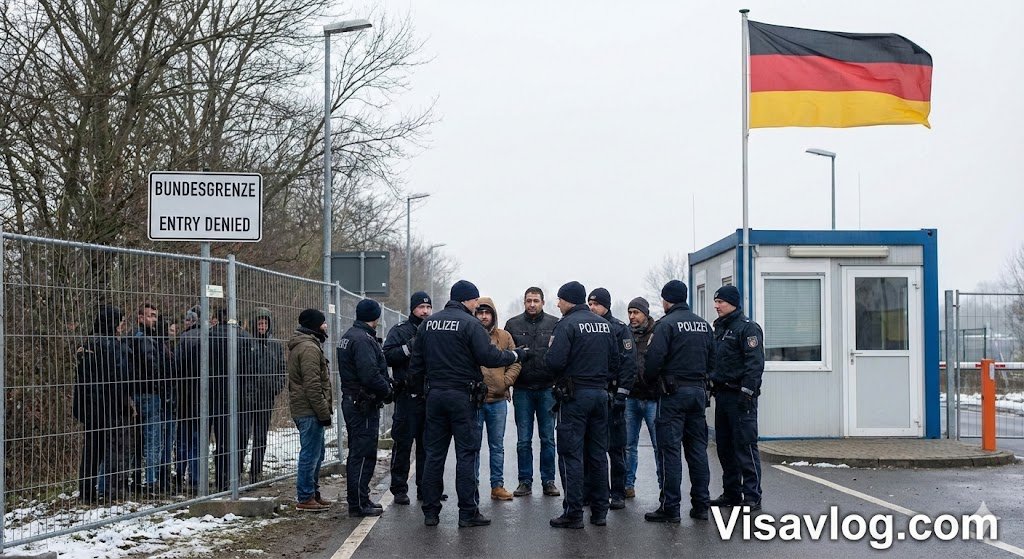
Germany reports 1,600 asylum requests from individuals initially rejected at the border between May and October 2025. Analysis of the 1,582 cases, the “turn-back” policy paradox, and the impact on BAMF processing and EU migration rules.
In a revelation that has sparked intense debate regarding the efficacy of European border controls, the German government has disclosed that hundreds of individuals who were initially denied entry at the nation’s borders subsequently managed to file asylum applications within the country. According to official data from the Federal Ministry of the Interior (BMI), approximately 1,600 asylum requests were lodged by people who had previously been turned away at German land borders.
This development highlights a critical and complex gap in the enforcement of migration policy: while stationary border controls can physically stop individuals at checkpoints, they do not necessarily negate the legal right to apply for asylum once an individual steps onto German soil or finds an alternative route into the country. The figures, covering the period between May and October 2025, suggest that despite stricter border protocols, the pathway to the asylum system remains accessible. This creates a complex dynamic for policymakers who are simultaneously trying to enforce borders while promoting Germany: From Fortress Bureaucracy to a Magnet for Talent to attract necessary skilled labor.
- Read More:
- Germany Tightens Citizenship Rules: 5-Year Residency Now Mandatory
- Germany: From Fortress Bureaucracy to a Magnet for Talent (2026 Policy)
- How to Become a German Citizen in 2026: Naturalization & Dual Citizenship
- How to Bring Your Family to Germany in 2026: Family Reunion Visa
- Study in Germany 2026: The Complete Guide for International Students
- Policy Reversal: Germany Repeals Fast-Track Citizenship Law
The Numbers: Breaking Down the 1,582 Cases
The specific figure released by the government is 1,582. These are individuals who were detected by the Federal Police (Bundespolizei) at German borders, formally rejected for entry (often due to a lack of valid travel documents or visas), and yet appear in the asylum statistics of the Federal Office for Migration and Refugees (BAMF) shortly thereafter.
This statistic covers a specific six-month window from May 7, 2025, to October 31, 2025. To understand the significance of this number, one must look at how border rejections function legally. When the Federal Police stop an individual at a land border—such as the borders with Austria, Poland, or the Czech Republic—they may issue a refusal of entry if the person does not wish to apply for asylum immediately or if they are subject to a re-entry ban. However, if that individual returns a few hours later or crosses via the “green border” (forests or fields away from checkpoints) and then finds a police station or reception center, they can legally apply for protection.
This irregular movement contrasts sharply with the structured legal pathways. For example, those who Study in Germany 2026 enter with pre-approved visas and clear residency conditions. However, once an irregular entrant speaks the word “asylum,” the police are generally obligated to hand the individual over to the initial reception facilities for processing, bypassing the initial border rejection.
Official Source: For more on the legal framework of border protection, visit the Federal Ministry of the Interior and Community (BMI).
The “Turn-Back” Policy Paradox
The core of the current controversy lies in the “turn-back” policy. Proponents of stricter migration control have long argued that individuals entering from safe third countries (like neighboring EU member states) should be immediately turned back at the border. However, EU law (specifically the Dublin Regulation) and international refugee conventions complicate this.
The 1,582 cases illustrate the practical limitations of physical border checks in an open Europe. Even if a person is turned back to Austria or Poland, there is little physical infrastructure to prevent them from trying again. The data suggests that for many, a rejection is merely a temporary delay rather than a final prohibition. This reality is forcing a re-evaluation of immigration policy. Recent reports indicate that Germany Tightens Citizenship Rules, making a clear distinction between those who integrate through legal employment and those entering the asylum system.
Critics of the current system argue that these numbers prove stationary border controls are “symbolic” rather than effective. They contend that without a comprehensive European solution or stricter detention capabilities at the border, the “revolving door” phenomenon will continue.
Procedural Gaps and Security Concerns
The report also sheds light on the administrative burden these cases place on the BAMF. When a person rejected at the border reapplies, their case must be treated as a new asylum application. This involves:
- Identity Verification: Re-establishing the identity of the person, often without documents.
- Dublin Checks: Determining if another EU country is responsible for the applicant.
- Security Screenings: Ensuring the individual poses no threat to public safety.
The fact that over 1,500 people managed to bypass the initial rejection implies a significant strain on federal resources. It raises questions about how data is shared between the Federal Police and the migration authorities. In an ideal system, a rejection at the border would be immediately flagged in all systems, potentially accelerating the processing of a subsequent claim. However, bureaucratic lag often means these individuals enter the standard, lengthy asylum procedure.
This creates a dual-track reality: one for asylum seekers facing bureaucratic hurdles, and another for settled residents learning How to Become a German Citizen in 2026, where the process is becoming streamlined for those who meet the strict criteria.
Official Source: Statistics and procedural details can be verified via the Federal Office for Migration and Refugees (BAMF).
Comparative Context: May to October 2025
The timeline of this data is crucial. The period from May to October 2025 saw high migration pressure across the European Union. While Germany has attempted to secure its borders, the sheer length of its land boundaries makes total sealing impossible.
The breakdown of nationalities among the 1,582 applicants mirrors the broader migration trends of 2025, with significant numbers originating from conflict zones in the Middle East and Central Asia. For these groups, established community networks act as powerful pull factors. Unlike those using the official How to Bring Your Family to Germany in 2026 legal routes, which require income proof and housing, asylum seekers are driven by immediate protection needs, often outweighing the deterrent effect of border police.
The Legal vs. The Practical Reality
Legally, Germany is bound by the non-refoulement principle, which forbids returning asylum seekers to a country where they face persecution. While neighboring EU countries are considered safe, the administrative act of transferring an applicant back to them (under Dublin rules) is notoriously slow and inefficient. Consequently, many who are “rejected” at the border are simply entering a different queue—the internal asylum queue—rather than actually leaving the German territory permanently.
This 1,582 figure is likely to become a focal point for future legislative proposals. It provides concrete data for those arguing that the current border regime is insufficient and that Germany requires a more robust mechanism to enforce rejections, potentially involving detention centers at the border or expedited processing zones that operate extraterritorially.
As 2026 approaches, the German government faces the difficult task of reconciling its international humanitarian obligations with the public demand for orderly and controlled borders. The discrepancy between the number of rejections and the number of subsequent applications serves as a stark reminder that in the world of migration, a “no” at the border is rarely the end of the story.