
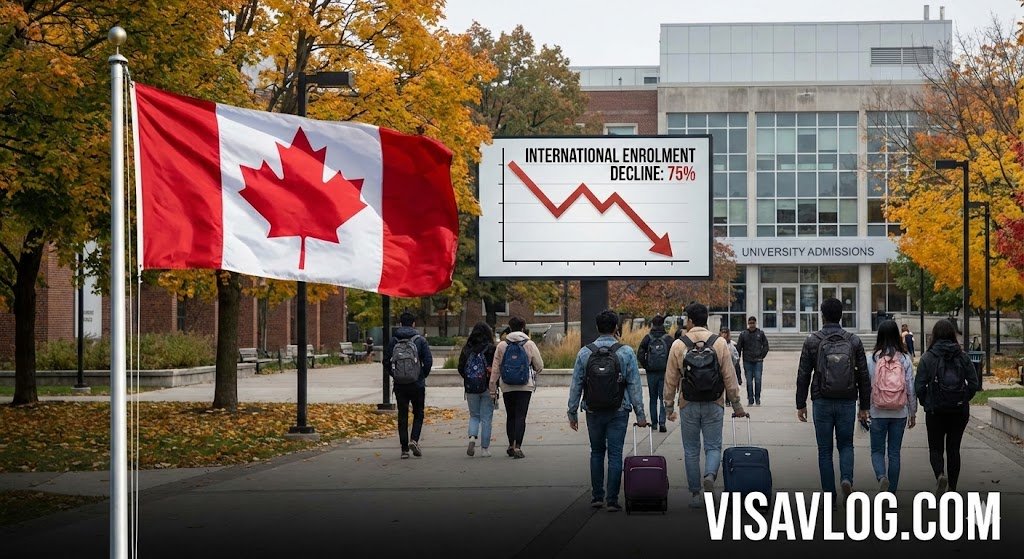

International enrolment declines hit 75% of Canadian universities in 2025. Discover how strict study permit caps and spousal work permit changes are reshaping Canada’s education sector and what future students need to know. Read the full report on Visavlog.com
The landscape of higher education in Canada is undergoing a significant and painful transformation, marked by a sharp decrease in international student numbers. Recent data indicates that international enrolment declines have hit 75% of Canadian universities, a statistic that has sent shockwaves through the academic, economic, and immigration sectors. This downturn is not merely a statistical anomaly or a temporary blip; it is a reflection of deeper structural changes driven by evolving government policies, shifting global mobility trends, and intense economic pressures. As institutions grapple with budget cuts and potential layoffs, the implications of this shift extend far beyond the campus, influencing the broader Canadian labour market and immigration targets for years to come.
According to the latest Global Enrolment Benchmark Survey, the drop in numbers is stark and unprecedented. Approximately 82% of Canadian universities reported lower undergraduate enrolments in 2025 compared to the previous year. The decline is even more pronounced when examining specific study levels, with a staggering 36% drop at the bachelor’s level and a 35% drop in master’s programs. Experts suggest that this trend is strategic rather than cyclical, heavily influenced by the federal government’s decision to implement caps on study permits. These policy shifts are reshaping the decision-making process for prospective students, many of whom are now looking at alternative destinations or reconsidering their study-to-immigration pathways entirely.
- Read more:-
- Study in Germany 2026: The Complete Guide for International Students
- Policy Reversal: Germany Repeals Fast-Track Citizenship Law
- Germany Welcomes More Skilled Immigrants
- How to Get a German Opportunity Card 2025
- The German Work Visa for Qualified Professionals: A Complete Guide
The Impact of Policy Changes on International Mobility
The primary driver behind this downturn is the tightening of immigration regulations. In an effort to manage temporary resident volumes and alleviate pressure on housing and infrastructure, the Canadian government has introduced restrictive measures that have directly impacted the attractiveness of Canada as a study destination. One of the most significant recent moves was when Canada Announces Immediate Cap on Spousal Open Work Permits & Cuts PR Targets. This policy change has created significant hurdles for mature students and professionals who previously viewed Canada as a family-friendly destination for higher education and subsequent permanent residence. The inability to bring spouses or the severe restrictions on their work rights have forced many potential applicants to withdraw their interest, seeking countries with more family-inclusive policies.
Furthermore, the uncertainty surrounding post-graduation work permits (PGWP) and the alignment of educational programs with labour market needs have added layers of complexity. Students are no longer guaranteed a straightforward path to permanent residency solely based on graduating from a Canadian institution. The government is increasingly prioritizing specific sectors and skills, which means that general arts or business degrees from certain institutions may no longer hold the same immigration value they once did. This realignment is causing a “flight to quality” or a shift towards programs that are explicitly linked to high-demand occupations in the Canadian economy. The days of using any generic diploma as a golden ticket to Canadian residency are effectively over, and the market is correcting itself accordingly.
Shifting Demographics and Future Workforce Trends
Despite the current dip in student enrolments, long-term demographic projections suggest that specific immigrant groups will continue to play a pivotal role in Canada’s future. It is widely reported that South Asians Projected to Become Canada’s Largest Immigrant Workforce by 2041. This projection highlights the enduring connection between Canada and South Asian countries, particularly India, which has been the largest source country for international students in recent years. However, even this robust pipeline is facing challenges due to diplomatic tensions and the aforementioned policy restrictions.
Universities are being urged to diversify their recruitment efforts to avoid over-reliance on a single source country. The decline in Indian student applications has been a major factor in the overall 75% drop faced by institutions. While the South Asian diaspora remains a critical engine for Canada’s growth, the current volatility serves as a warning. Canadian institutions must build bridges with other regions—such as Southeast Asia, Africa, and Latin America—to create a more balanced and resilient international student body. This diversification is not just about numbers; it is about enriching the cultural fabric of the campuses and ensuring a steady flow of talent from varied backgrounds.
New Pathways and Opportunities in Healthcare
Amidst the general tightening of rules and the “gloom and doom” of falling enrolments, there are still beacons of opportunity for specific professionals. Recognizing the acute shortage of medical professionals, the government has introduced specialized streams to retain and attract talent. Recently, Canada Launches New Express Entry Category for Physicians with Canadian Experience. This initiative allows doctors who have gained work experience in Canada—perhaps initially as students or temporary workers—to fast-track their permanent residency.
This is a clear signal that while general student numbers are being capped, Canada is rolling out the red carpet for high-impact professions that directly support the well-being of Canadians. For international students studying in health-related fields, this is a positive development. It suggests that despite the overall decline in enrolment numbers, those who pursue education in critical sectors like healthcare, nursing, and medical technology will still find favourable immigration outcomes. It underscores the importance of choosing a study program that aligns with Canada’s long-term labour shortages rather than simply opting for the easiest entry route. Future students must be more strategic than ever, aligning their educational investments with the categories prioritized by Immigration, Refugees and Citizenship Canada (IRCC).
Express Entry and Provincial Nominee Program Dynamics
The interaction between student enrolment and federal immigration selection systems like Express Entry cannot be overstated. Many international students rely on the points gained from their Canadian education to qualify for permanent residence. However, the system is becoming more competitive and unpredictable. For instance, in a recent development, Canada Issues Massive 6,000 Express Entry Invites as Ontario Suspends Trades Stream. Such fluctuations—massive federal draws contrasted with sudden provincial pauses—create a volatile environment for students planning their future.
A student might start a course expecting a certain provincial nomination stream to be open, only to find it suspended by the time they graduate. This volatility is contributing to the enrolment decline as prospective students perceive the “Canadian Dream” as becoming riskier. The suspension of trades streams in major provinces like Ontario affects students in vocational colleges particularly hard. These institutions have seen some of the steepest declines in applications. The message to prospective students is clear: the path from classroom to permanent residency is no longer linear, and reliance on provincial streams requires a backup plan and a keen understanding of the changing immigration landscape.
The Future of Canada’s Immigration Selection
Looking ahead, the structure of Canada’s immigration system is set to undergo further refinements that will impact how international graduates are selected. The government has signaled a move towards more category-based selection to better target economic needs. We are seeing this evolve as Canada Express Entry 2025: New Category-Based Draws & CRS Changes come into play. These changes will likely place greater emphasis on French language proficiency, healthcare, STEM (Science, Technology, Engineering, and Math), and trade occupations.
For universities, this means that programs falling outside these priority categories may continue to see depressed enrolment numbers. Institutions that focus heavily on general business administration or hospitality management—programs that were previously popular among international students seeking a quick route to residency—may struggle to recover their numbers. Conversely, faculties of engineering, medicine, and computer science may see sustained interest, provided they can navigate the cap restrictions.
Economic Consequences for Universities
The financial impact of this enrolment decline is immediate and severe. International tuition fees have long subsidized domestic education and research funding in Canada. With a significant portion of that revenue stream drying up, universities are facing hard choices. Reports indicate that 60% of Canadian universities plan to cut budgets in the coming year, and half are anticipating staff layoffs. This contraction will likely lead to larger class sizes, reduced student services, and a potential stagnation in research output.
It also forces a re-evaluation of the business model of Canadian higher education. For too long, the system relied on year-over-year growth in international student numbers. Now, institutions must pivot towards sustainability, quality, and student experience. The focus must shift from recruitment volume to retention and success, ensuring that those who do come to Canada have a high-quality education and a realistic path to career success.
The 75% decline in international enrolment across Canadian universities is a wake-up call. It signals the end of an era of easy expansion and the beginning of a more regulated, targeted, and competitive environment. While the immediate effects are painful—budget cuts, layoffs, and fewer students—the long-term result may be a system that is better aligned with Canada’s economic needs and housing capacity. For prospective students, Canada remains a top-tier destination, but only for those who are willing to navigate a complex policy landscape and choose their path wisely.