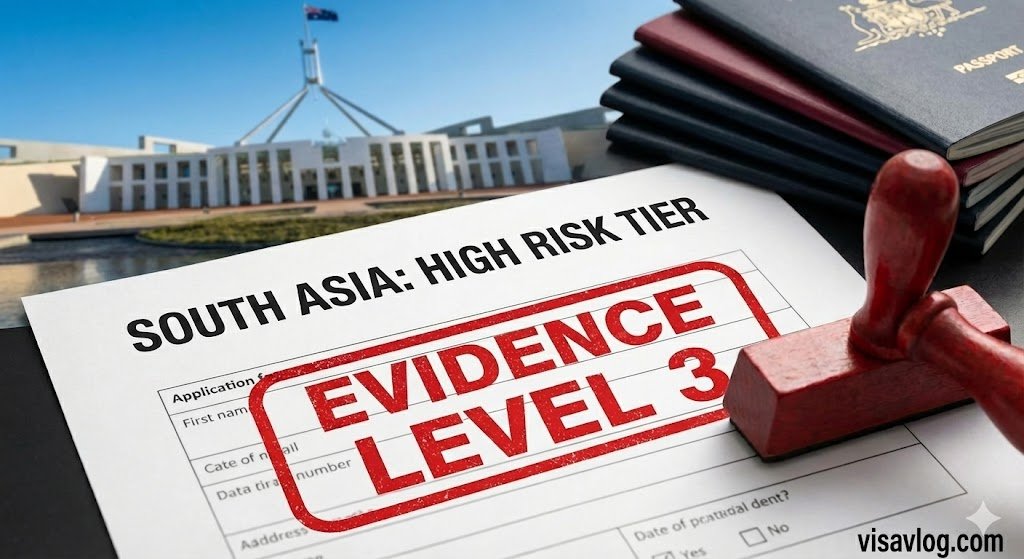

The Australian immigration landscape has undergone a tectonic shift in the opening weeks of 2026. For years, Australia remained one of the most accessible destinations for international students from South Asia. However, following a series of integrity reviews throughout 2025, the Department of Home Affairs (DHA) issued an emergency notice on January 8 and 9, 2026. This notice effectively moved Pakistan, India, Nepal, Bangladesh, and Bhutan into Evidence Level 3, the highest risk category within the Simplified Student Visa Framework (SSVF).
This designation is not merely a bureaucratic change; it represents a fundamental pivot in how Australia views its international education sector. The primary driver behind this “High Risk” status is the alarming increase in non-genuine visa applications and the widespread use of fraudulent financial documents. For students and education consultants, this means the era of “streamlined” processing for South Asia is over. Every file will now be scrutinized with a level of detail previously reserved for high-security clearance visas.
Why Evidence Level 3? The Root Causes
According to official statements from the Minister for Home Affairs, the decision was forced by three primary factors:
- Document Integrity: A significant percentage of financial documents submitted from the South Asian region were found to be either altered or completely fabricated.
- The “Course Hopping” Phenomenon: Thousands of students arrived in Australia on university-level visas only to immediately “hop” to cheaper, non-accredited private colleges to work full-time, undermining the integrity of the student visa program.
- Labor Market Protection: The Australian government is under domestic pressure to ensure that the student visa program is used for education, not as a back-door entry for low-skilled labor.
- Read More
- Canada Issues 6,000 Express Entry Invites Amid Fraud Crackdown
- Sweden Proposed 3-Year Time Limit on SFI Language Classes
- US Suspends Green Card Lottery Indefinitely Following Shootings
- How to Switch Student Visa to Skilled Worker in the UK (2025 Rules)
- Europe’s Top 4 Salary Countries in 2026: Cost of Living Reality
Enhanced Financial Requirements: The 12-Month Rule
The most significant hurdle under Evidence Level 3 is the Financial Capacity requirement. Under previous Level 2 rules, many students could bypass detailed financial evidence if they were enrolled in a high-ranking (Level 1) university. That luxury has vanished.
1. Mandatory 12-Month Bank Statements
Applicants must now show a consistent history of funds. The Department of Home Affairs now demands 12 months of bank statements to prove that the money has not been “parked” or borrowed temporarily. The visa officer will look for “source of funds”—meaning you must prove where the money came from (e.g., salary, property sale, or agricultural income).
2. Manual Verification Protocol
In 2026, the Australian High Commissions in Islamabad, New Delhi, and Dhaka have been equipped with specialized verification units. These units will perform manual verification, which involves:
- Directly contacting banks to verify the authenticity of balance confirmation letters.
- Checking tax records (FBR in Pakistan, ITR in India) to ensure the sponsor’s income matches the bank deposits.
- Verifying property valuation reports through local authorities.
3. Increased Living Cost Threshold
Due to inflation in 2026, the minimum required funds for a single student have been adjusted. You must now show:
- One year of tuition fees.
- One year of living costs (Approx. AUD 30,000+).
- Travel expenses (Approx. AUD 2,500).
Academic Integrity and “Bogus” Colleges
The Australian government has also identified a “category” of private vocational providers that primarily exist to facilitate work rights rather than education. Under the 2026 guidelines, enrolling in a “Low-Tier” or “Level 3” institution while being from a “Level 3” country is a recipe for an immediate visa refusal.
The Genuine Student (GS) Requirement
The Genuine Student (GS) test has replaced the old GTE (Genuine Temporary Entrant) requirement. In 2026, the GS criteria are even more focused on your “Incentives to Return.” You must provide a detailed statement of purpose that explains:
- How the chosen course directly relates to your previous education or employment history.
- The economic value of the Australian degree in your home country’s job market.
- Your social and economic ties to Pakistan or your home country that will compel you to return after graduation.
- Important Note: If a visa officer suspects your primary motive is to work rather than study, they have the authority to refuse the visa under Public Interest Criterion 4020 (PIC 4020), which can lead to a 10-year ban from Australia.
Impact Comparison: Level 2 vs. Level 3 (2026)
| Requirement | Previous (Level 2) | New (Level 3 – 2026) |
| Financial Evidence | Often waived for Level 1 Unis | Mandatory for all |
| Bank History | 3 to 6 months usually sufficed | 12 months mandatory |
| Verification | Random / Sample checks | 100% Manual Verification |
| Processing Time | 4 to 6 weeks | 8 to 12 weeks |
| English Proficiency | IELTS 6.0 (usually) | Strict adherence to sub-scores |
Strategic Advice for 2026 Applicants
To succeed in this “High Risk” environment, students must adapt their strategy. VisaVlog.com recommends the following steps to ensure your application stands out for the right reasons:
- Prioritize University Level 1 Institutions: While the country risk is Level 3, applying to a top-tier university still carries weight. It demonstrates that you are a high-caliber student capable of academic rigor.
- Full Disclosure of Sponsors: Ensure that your sponsors (usually parents) have documented proof of income. If they are business owners, provide three years of audit reports and tax filings.
- Avoid “Gap” Years without Evidence: If you have been out of school for more than 6 months, you must provide documented proof of employment, including salary slips and experience letters.
- Prepare for Interviews: Phone interviews are becoming standard again in 2026. Be ready to answer detailed questions about your course modules, the university’s location, and your future career path in your home country.
A New Era of Quality
The 2026 “High Risk” designation for South Asia is a clear signal that Australia is prioritizing Quality over Quantity. While this makes the process more difficult, it also means that the students who do make it to Australia will be more respected and better protected from “predatory” education providers.
The Department of Home Affairs is constantly updating its Document Checklist Tool. We strongly advise all VisaVlog.com followers to double-check their specific requirements 24 hours before submitting their application, as policies are currently evolving on a weekly basis.
Australia Visa Evidence Level 3: FAQ 2026
As of January 2026, the Australian Department of Home Affairs has designated Pakistan and other South Asian nations as Evidence Level 3 (High Risk) due to a significant increase in fraudulent financial documents and non-genuine student applications. This move allows visa officers to perform stricter background checks and demand more extensive evidence before granting a visa.
Under Level 3 rules, applicants must show a consistent history of funds. You are now required to provide 12 months of bank statements to prove the money in your account is stable and not borrowed temporarily for the application. Any sudden large deposits without a documented source (like a property sale or salary) may lead to a visa refusal.
Yes. In early 2026, because the country risk for South Asia is Level 3, the previous “streamlined” exemptions have been suspended. Regardless of your university’s ranking, all applicants from high-risk regions are currently required to submit full financial evidence and undergo manual verification.
Manual verification means that visa officers from the Australian High Commission will directly contact your bank, tax authorities (such as the FBR), and educational institutions to verify your documents. This process is rigorous and can extend visa processing times to 8-12 weeks.
The 2026 adjusted living cost requirement for a single student is approximately AUD 30,000 per year. This is in addition to your first year’s tuition fees and return airfare (approx. AUD 2,500). If you are bringing dependents, the amount increases significantly. Always check the official VisaVlog.com updates for the latest currency conversion rates.