
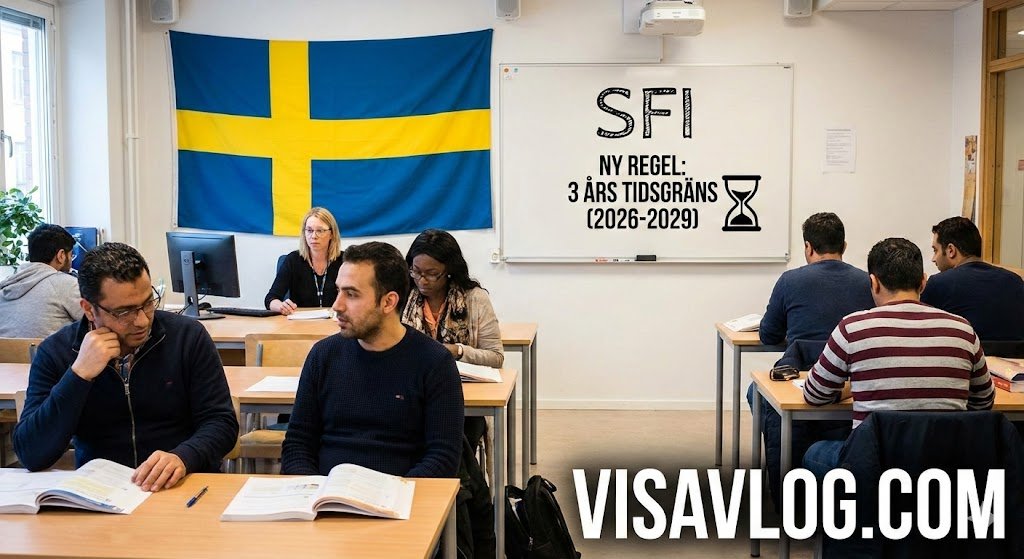

Starting January 1, 2026, Sweden enforces a strict 3-year time limit on SFI (Swedish for Immigrants) courses. Failure to meet this deadline may jeopardize future residency and citizenship. Read our comprehensive guide on the new rules, exemptions, and strategic advice for expats.
In a transformative move that redefines the expectations for foreign residents, the Swedish government is set to implement rigid new regulations for Swedish for Immigrants (SFI) education. Effective January 1, 2026, a strict three-year maximum time limit will be imposed on state-funded language studies. This policy, a direct outcome of the Tidö Agreement, ends the era of open-ended learning and signals a shift toward a “performance-based” residency model.
For the thousands of expatriates, work permit holders, and asylum seekers currently navigating life in Sweden, this is not merely an administrative update—it is a critical compliance checkpoint. With the Migration Agency increasingly tying residency rights to verifiable integration, failing to complete SFI within this new window could have severe downstream effects on your ability to secure permanent status.
This detailed guide explains the mechanics of the new law, how it interacts with other 2026 immigration reforms, and the immediate steps you must take to protect your future in Scandinavia.
- Read More:
- South Asians Projected to Become Canada’s Largest Immigrant Workforce by 2041
- Harder Than Ever: The Challenges of Being an Immigrant in the USA in 2026
- Sweden Finalizes Bill to Hike Work Permit Salary Threshold to 33,390 SEK by 2026
- New Saudi Labor Laws: Agricultural & Herding Workers Granted 30-Day Paid Leave
- Germany Tightens Citizenship Rules: 5-Year Residency Now Mandatory
The Core of the New Law: The 3-Year Countdown
The legislation, which becomes active in just a few days on New Year’s Day 2026, mandates that any student enrolled in municipal adult education (Komvux) for SFI must complete their specific course track within three years.
Previously, the system was criticized for allowing students to linger in introductory courses for five or even ten years without significant progress. The government argues this inefficiency delays entry into the workforce and contributes to segregation. The new strict deadline is designed to force quicker integration.
How the Timeline Works
- New Students: For anyone registering on or after January 1, 2026, the clock starts ticking on day one. You have exactly 36 months to finish Course D (the final level).
- Existing Students: If you are already studying, you are granted a “reset.” Your three-year countdown effectively begins on January 1, 2026, giving you until the end of 2028 to finish.
- The Penalty: If you fail to complete the course within the timeframe, you will be deregistered. This means you lose the right to free, taxpayer-funded education. While you can technically pay for private tutoring, losing your spot in the official municipal system disconnects you from the standard verification path used by immigration authorities.
This tightening of educational standards coincides with broader enforcement measures. Just last week, Sweden announced a major crackdown and a 2026 plan to monitor foreigners and dismantle the so-called “shadow society.” The synchronization of these policies suggests that educational attendance data may increasingly be shared between schools and the Migration Agency to ensure compliance.
Impact on Work Permits and Permanent Residency
For work permit holders, the stakes are particularly high. While SFI attendance is not currently a strict legal requirement for a temporary work permit renewal, the landscape is shifting rapidly.
The government has explicitly stated its intention to introduce language requirements for Permanent Residence (PUT). By placing a time limit on SFI now, the state is effectively creating a “filter.” If you are timed out of SFI in 2029, you may find yourself unable to produce the required language certificate when you eventually apply for permanent residence.
Moreover, this rule puts additional pressure on low-income workers. Many are already struggling to meet the new financial demands, especially since Sweden finalized the bill to hike the work permit salary threshold to 33,390 SEK. The combination of demanding higher salaries and faster language acquisition creates a “double squeeze” on foreign workers, forcing them to excel professionally and socially simultaneously or face exclusion.
The Danger for Citizenship Applicants
The path to a Swedish passport is also becoming narrower. The new SFI limit acts as a precursor to the proposed “Citizenship Language Test.” If you cannot finish SFI within three years, passing a standardized citizenship exam will be significantly harder.
Furthermore, “good conduct” is now a central pillar of naturalization. The authorities are taking a harder look at an applicant’s entire history in Sweden. Under new regulations, Swedish citizenship can be stripped for misleading info or improper conduct. While failing a class isn’t a crime, a pattern of non-compliance or “lack of progress” could theoretically be used to build a case against an applicant’s willingness to integrate, especially if they are relying on social benefits.
Exceptions: Who Can Get More Time?
The law does provide a safety valve, but it is tight. Municipalities can grant extensions beyond three years only under “special circumstances” (särskilda skäl).
Valid reasons for an extension include:
- Parental Leave: Time spent on föräldraledighet can be deducted from the count.
- Medical Issues: Documented long-term illness that physically prevents attendance.
- Part-time Study: In some cases, if you are combining study with full-time work, you might get leeway, but this is not guaranteed.
However, general “busyness” or a lack of motivation will not be accepted. This rigid approach mirrors the state’s attitude toward family reunification, where Sweden proposes a major tightening of family immigration rules. Just as families must now prove high income, individuals must now prove rapid learning.
The Broader Context: A Hostile Environment?
Critics argue that these measures, when viewed together, create a hostile environment for immigrants. The emphasis is shifting from “support” to “requirements.”
If you fail to navigate these new rules, the ultimate risk is not just losing a class, but losing your right to stay. Statistics show that enforcement is already ramping up, and we are seeing clear reasons why deportations from Sweden are increasing in the 2025-2026 shift. The 3-year SFI limit is just one more rule where a slip-up could be costly.
Strategic Action Plan for 2026
To safeguard your residency status, take these steps immediately:
- Audit Your Enrollment: Contact your school next week. Confirm they have registered your “start date” correctly under the new system.
- Prioritize the Certificate: Treat SFI Course D like a job. It is your most valuable document after your employment contract.
- Document Gaps: If you take a month off for travel or sickness, ensure it is officially recorded. You may need that evidence years from now to request an extension.
The days of casual learning are over. Welcome to the new reality of Swedish integration.
Common Questions About the New SFI Rules
Yes, but you get a fresh start. For existing students, the 3-year countdown officially resets and begins on January 1, 2026. This means you have until January 1, 2029, to complete your studies, regardless of how long you studied before 2026.
If you do not complete the course within the time limit, you will be deregistered from the municipal SFI program. You will lose the right to free Swedish education provided by the municipality (Komvux) and may have to pay for private classes to continue learning.
Indirectly, yes. While SFI completion is not a strict requirement for PUT today, the government plans to introduce language requirements for permanent residence in 2027. If you are kicked out of SFI now, you may struggle to provide the necessary proof of language proficiency when those new laws kick in.
Generally, working full-time is not considered a “special reason” for an extension, as SFI is designed to be combined with work (flex or evening classes). Extensions are typically reserved for parental leave, documented long-term illness, or other humanitarian circumstances.
Yes. The Education Act (Skollagen) applies to all residents registered in Sweden. Whether you are a German citizen or a Pakistani work permit holder, the 3-year limit on state-funded SFI applies equally to everyone.