
UK passport changes in 2026 introduce the new King Charles III design and updated passport fees. This comprehensive guide covers the mandatory UK ETA for visitors, the shift to eVisas for residents, and new Skilled Worker salary thresholds. Stay compliant with official Home Office rules by visiting Visavlog.com for the latest travel and immigration news.
The year 2026 stands as a landmark for the United Kingdom’s border and immigration policy. Following the coronation of His Majesty, the transition from paper-based systems to a “Digital by Default” border is reaching its final implementation stages. Whether you are a British citizen renewing a passport, a foreign national living in the UK, or a tourist planning a visit, understanding these updates is critical for seamless travel.
According to official data from GOV.UK, these updates are designed to enhance security while streamlining international travel. Below is a comprehensive guide to all the UK passport and immigration changes taking effect in 2026.
1. The Historic King Charles III Passport Redesign
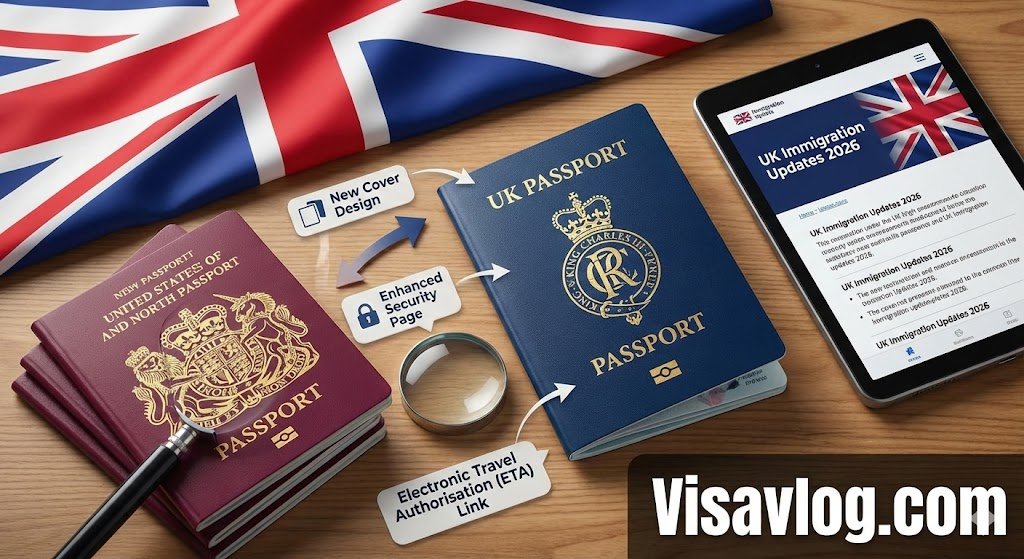
As of early 2026, the HM Passport Office has fully transitioned to issuing passports featuring the Coat of Arms of His Majesty King Charles III.
- Front Cover Update: The new navy blue passports now bear the King’s crest and the updated wording: “His Britannic Majesty’s Secretary of State requests and requires in the Name of His Majesty…” replacing the previous reference to Her Majesty.
- Internal Security: The 2026 edition is the most secure British travel document to date. It utilizes polycarbonate data pages and laser-engraving technology to prevent identity theft.
- The History of the Transition: The rollout began in late 2023, but 2026 marks the point where nearly all newly issued documents feature the Carolean design. This change occurs only upon the natural expiration of existing documents to ensure environmental sustainability and cost-efficiency for the taxpayer.
- Validity of Old Passports: If you hold a passport featuring the late Queen Elizabeth II, you do not need to replace it. It remains 100% valid until its expiry date. You can check your passport’s validity for travel on the official renewal page.
- Read More
- Canada Immigration 2026: Major Changes to Study Permits and PR Targets
- UK Skilled Worker Visa Update 2026: Mandatory B2 English Requirement
- Trump Expands Travel Ban to 39 Countries: The Complete Official List
- Italy New Immigration 2026: 150,000 Work Visas Announced
- Saudi Arabia Leads Global List for Deporting Foreign Workers in 2025
2. Official UK Passport Fees for 2026
Following the fee adjustments in 2025, the costs for renewing or applying for a British passport remain standardized for 2026. Official government policy continues to favor online applications, which are significantly cheaper and faster than paper-based ones.
| Application Type | Online Application Fee | Postal (Paper) Fee |
| Standard Adult (34-page) | £94.50 | £107.00 |
| Standard Child (under 16) | £61.50 | £74.00 |
| Frequent Traveller (54-page) | £107.50 | £120.00 |
| Frequent Traveller Child | £74.50 | £87.00 |
- The Frequent Traveller Option: For those who travel extensively for business or leisure, the 54-page passport provides 20 extra pages for visa stamps. This is highly recommended to avoid the higher cost of early renewal due to a full passport.
- Overseas Applications: For those residing abroad, the overseas application fees are higher due to international courier and processing costs, starting at approximately £112.85 for adults.
3. Mandatory UK Electronic Travel Authorisation (ETA)
By February 25, 2026, the UK Electronic Travel Authorisation (ETA) system will be fully operational for all visa-exempt nationalities, including citizens of the USA, Canada, Australia, and the EU.
- What is it? A digital permission to travel to the UK. It is electronically linked to your passport and removes the need for physical travel documents for many visitors.
- Cost: The ETA fee is £10.
- Validity: Once granted, it is valid for two years or until your passport expires. It allows multiple entries for stays of up to six months for tourism, visiting family, or short-term business.
- How to Apply: Visitors should only use the official GOV.UK ETA service or the official UK ETA app. Beware of unofficial websites that charge “service fees” on top of the £10 government fee.
4. The Transition to eVisas (Ending Physical BRPs)
In a move toward a “Digital by Default” border, the UK has phased out physical Biometric Residence Permits (BRPs) and vignette stickers. By 2026, all residents must manage their immigration status through a UKVI Account.
- Action Required: If you previously held a physical BRP, you must create a digital account to access your eVisa. Failure to do so could result in delays when trying to re-enter the UK from abroad.
- Linking Passports: It is critical that your eVisa is linked to your current passport. If you renew your passport and receive the new King Charles III version, you must update your details immediately via the official ‘Update your UKVI account’ service.
- Proof of Status: To prove your right to work or rent, you must now generate a “share code” through the View and Prove service. Employers and landlords are now legally required to check these digital codes rather than physical cards.
5. Travel to Europe: EES and ETIAS for British Citizens
British passport holders traveling to the Schengen Area in 2026 must comply with new European Union digital systems, which are the counterpart to the UK’s ETA system.
- Entry/Exit System (EES): Fully operational at EU borders, the EES replaces manual passport stamping with biometric registration. On your first trip to Europe in 2026, you will be required to provide fingerprints and a facial scan at the border. You can find more details on the EU’s official EES page.
- ETIAS Requirement: Expected to be fully active in 2026, the ETIAS (European Travel Information and Authorisation System) will require UK citizens to pay a €7 fee for a three-year travel authorization to enter the EU.
6. New Immigration Salary Thresholds (2026)
The Home Office has implemented stricter financial requirements for work and family visas to manage net migration and ensure the UK attracts high-skilled talent.
- Skilled Worker Visa: The general salary threshold has risen to £41,700 for most new applicants. Detailed eligibility criteria can be found on the Skilled Worker visa page.
- Spouse & Family Visas: The Minimum Income Requirement (MIR) for sponsoring a partner has now reached its full implementation of £38,700. This ensures that families can be supported without recourse to public funds.
- Health and Care Workers: While exempt from the higher £41,700 threshold, the general minimum for this route has also seen an inflationary increase to £31,300. Check the Health and Care Worker visa rules for specific exemptions.
7. Impact on British Overseas Territories and Dependencies
The 2026 changes also clarify the rules for those holding British Overseas Territories (BOT) passports. While BOT citizens generally do not need a visa for the UK, they must ensure their passports meet the new digital standards. Those traveling on a BOT passport should use the official visa checker to confirm if an ETA is required for their specific territory, as rules can vary between regions like Bermuda, the Cayman Islands, and Gibraltar.
8. Domestic Changes: National Living Wage and Pensions
Beyond travel, several domestic policy changes in 2026 affect those living in the UK, impacting everything from visa eligibility to general cost of living:
- National Living Wage: In April 2026, the National Living Wage is scheduled to increase. This increase often triggers a review of the “going rates” for Skilled Worker visas.
- State Pension: The “Triple Lock” remains in place, ensuring pensioners receive an increase based on the highest of inflation, earnings growth, or 2.5%. Detailed pension rates are available on the State Pension guidance page.
Summary of Official Resources
For the most accurate and safe experience, always use these direct links to the UK Government’s official website:
- Apply for or renew your passport
- Apply for a UK ETA
- Access your eVisa (UKVI Account)
- Check if you need a visa to enter the UK
- Update your UKVI account details
Common Inquiries: UK Passport & Travel 2026
1. Do I need to replace my Queen Elizabeth II passport immediately?
No, there is absolutely no requirement to replace your current passport if it is still valid and in good condition. All British passports featuring the Coat of Arms of Her Late Majesty Queen Elizabeth II remain fully valid travel documents until their official printed expiry date. You will only receive the new King Charles III design when you naturally apply for a renewal or a replacement due to loss or damage. This approach ensures a sustainable transition while avoiding unnecessary costs for citizens and the government.
2. What is the deadline for the new UK ETA system?
The full enforcement deadline for the Electronic Travel Authorisation (ETA) is February 25, 2026. After this date, all visitors from visa-exempt countries, including the EU, USA, and Australia, must have a digital ETA before they can board a flight, train, or ferry to the UK. The application costs £10 and is linked directly to your passport for two years. Failing to secure this permission in advance will result in a denial of boarding by your carrier, as the system is now fully integrated with airline manifests.
3. How do I prove my right to work without a physical BRP card?
Since physical Biometric Residence Permits (BRPs) have been phased out, you must use the official UK Government “View and Prove” service to demonstrate your status. You simply log into your UKVI account, which generates a temporary “share code” that you provide to your employer or landlord. They will then enter this code on the government website to verify your eligibility digitally. This system is designed to be more secure and prevents the loss or theft of physical documents while providing real-time immigration status checks.
4. What should I do if I get a new passport but have an eVisa?
It is critical that your current immigration status (eVisa) is digitally linked to the passport you are currently using for travel. If you renew your passport and receive the new King Charles III version, you must log into your UKVI account immediately to update your passport details. If you arrive at the UK border with a new passport that hasn’t been linked to your eVisa, the automated gates will not open, and you may face significant delays with immigration officers. This update can be done entirely online via the GOV.UK “Update your UKVI account details” service.
5. Are there extra costs for frequent travellers in 2026?
Frequent travellers who require more space for visas and stamps should opt for the 54-page “Jumbo” passport, which costs £107.50 when applied for online. This is slightly more expensive than the standard 34-page book but prevents the high cost of an early renewal if your pages become full before the 10-year expiry. In 2026, while many countries are moving toward digital stamps (like the EU’s EES), many major destinations still require physical space for stickers and stamps. Planning ahead with a larger book is a cost-effective strategy for those visiting multiple non-digital jurisdictions.
6. How does the EU Entry/Exit System (EES) affect UK passport holders?
As a UK passport holder entering the Schengen Area in 2026, you will no longer receive a manual ink stamp in your book; instead, your data is recorded in the EES. Upon your first entry, you will be required to provide biometrics, including fingerprints and a facial scan, at the border control point. This system automatically tracks your 90-day stay allowance within any 180-day period across the entire Schengen zone. It is designed to modernize border security and ensure that non-EU citizens do not overstay their visa-free privileges.
7. Can I still apply for a passport using a paper form at the Post Office?
Yes, the paper-based application service remains available at participating Post Offices, but it is significantly more expensive than the digital route. Applying via a paper form costs £107.00 for an adult, compared to £94.50 for an online application. Furthermore, the “Check and Send” service at the Post Office carries an additional service fee. Most users now prefer the online method as it allows you to take a photo with your smartphone and provides digital tracking, making it the fastest and most reliable way to obtain your new King Charles III passport.