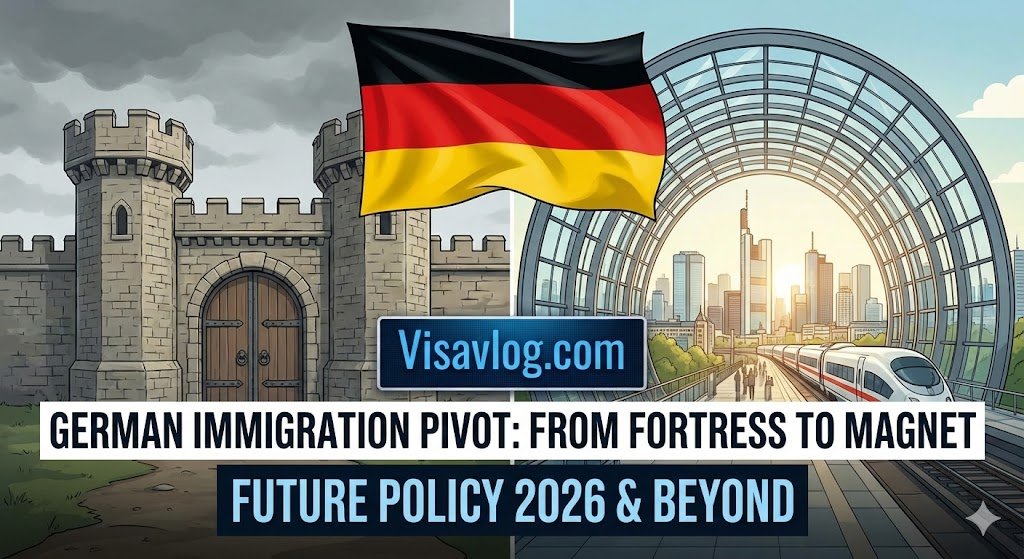

Germany is currently navigating one of the most profound socio-political shifts in its modern history. For decades, the phrase “Germany is not a country of immigration” (Deutschland ist kein Einwanderungsland) was a persistent political mantra, despite the demographic reality on the ground. However, the last five years have forced a reckoning. Faced with an aging population, a shrinking workforce, and a desperate need for skilled labor to maintain its industrial might, Berlin has fundamentally rewritten its immigration playbook.
As we look toward 2026, we are witnessing the implementation of a new “Grand Bargain” in German migration policy: a massive liberalization of legal labor migration channels combined with a stricter, more efficient management of irregular migration. This column explores where Germany has been, where it is going, and the specific government mechanisms driving this transformation.
The Context: Why the Shift Was Inevitable
To understand the future, one must recognize the failure of the past. The period from 2020 to early 2025 was characterized by a system that was theoretically open but practically obstructed by what experts called the “German Certificate Fetish.”
In the previous era, German immigration policy was rigid and degree-obsessed. To obtain a work visa, a candidate essentially needed two difficult things: a concrete job offer and a qualification that was fully recognized as equivalent to a German degree. This “recognition procedure” (Anerkennungsverfahren) was a bureaucratic bottleneck, often taking months or years. Furthermore, the political discourse was heavily dominated by the aftermath of the refugee crisis, viewing migration primarily through the lens of asylum (protection) rather than labor (opportunity).
The turning point came with the realization that Germany needs approximately 400,000 net new immigrants per year just to sustain its labor market. This demographic urgency birthed the reforms that are now the standard for 2026.
- Read more:-
- How to Become a German Citizen in 2026: The Ultimate Guide
- How to Bring Your Family to Germany in 2026: Family Reunion Visa Guide
- Study in Germany 2026: The Complete Guide for International Students
- Germany Opportunity Card 2025: How to Get It
- How to Apply for German Permanent Residence (Niederlassungserlaubnis)
Pillar 1: The “Chancenkarte” (Opportunity Card) and the Points-Based Revolution
The most significant philosophical break from the past is the full implementation of the Opportunity Card (Chancenkarte).
For the first time in its history, Germany allows non-EU citizens to enter the country without a job offer specifically to look for work. This system, which is fully operational in 2026, uses a points-based metric similar to the Canadian or Australian models.
- How it works: Candidates are awarded points for language skills (German or English), work experience, age, and connection to Germany.
- The Official Stance: According to the Federal Ministry of the Interior and Community (BMI), this measure is designed to remove the “Catch-22” where you couldn’t get a visa without a job, but couldn’t get a job without being in the country for an interview.
- The Future Impact: By 2026, this system shifts the risk from the employer to the state. It acknowledges that “potential” is as valuable as a pre-signed contract. This is a massive deregulation designed to attract young, ambitious talent who may not yet have a corporate sponsor.
Pillar 2: “Experience over Certificates” – The Skilled Immigration Act
The second major pillar of the future policy is the modernization of the Skilled Immigration Act (Fachkräfteeinwanderungsgesetz).
The new rules for 2026 have dismantled the “recognition bottleneck.” Previously, an IT specialist from India or a welder from Brazil needed their training to be 100% equivalent to the German dual-education system—a nearly impossible standard for many.
- The New Rule: Now, experts can enter Germany if they have:
- At least two years of professional experience.
- A degree or vocational training recognized by the state in their home country.
- A salary above a certain threshold.
- Official Verification: The government has streamlined this through the Central Service Point for Professional Recognition (ZSBA), which now operates with a mandate to facilitate rather than block entry.
- The Shift: This moves Germany from a system of “formal qualification” to a system of “proven competence.” In the future, IT specialists, for example, will face significantly lower barriers, often bypassing the degree requirement entirely if they can prove their skills.
Pillar 3: The Modernization of Citizenship (The New Staatsangehörigkeitsrecht)
Perhaps the most emotional and symbolic change for 2026 is the radical overhaul of Germany’s citizenship laws. The government has officially recognized that to attract the best minds, it must offer them a permanent home, not just a temporary guest worker status.
According to the Federal Government’s official bulletin on Nationality Law, the new “Modernization of the Nationality Law” (StARModG) includes two game-changing provisions:
- Faster Naturalization: The standard waiting time for a German passport has dropped from 8 years to 5 years. For those who integrate exceptionally well (showing C1 language skills or high professional achievement), naturalization is now possible in just 3 years.
- Dual Citizenship: In the past, becoming German usually meant renouncing your old passport. The future policy embraces multiple identities. This allows Turkish-Germans, US-Germans, and others to become full citizens without severing ties to their heritage. This aligns Germany with other modern immigration nations and removes a major psychological barrier for applicants.
Pillar 4: The “Two-Lane” Strategy – Harder Borders, Softer Doors
It is crucial for observers to understand that while labor migration is becoming liberal, asylum and irregular migration policies are hardening. This is the “Two-Lane” strategy: opening the front door for workers while locking the back door for irregular entry.
The Federal Ministry of the Interior (BMI) has been explicit about the “Repatriation Improvement Act” (Rückführungsverbesserungsgesetz).
- Stricter Enforcement: The state is implementing faster deportation procedures for rejected asylum seekers and criminals. This includes extended detention periods pending deportation to prevent absconding.
- Digital Borders: The Federal Office for Migration and Refugees (BAMF) is heavily investing in digitalization to process asylum claims faster, distinguishing quickly between those who need protection and those who are economic migrants (who should be routed to the Chancenkarte system instead).
Summary: The Structural Shift (Then vs. Now)
| Feature | The Past (2020-2025) | The Future (2026 & Beyond) |
| Primary Entry Requirement | Concrete Job Offer + Recognized Degree | Opportunity Card or Experience |
| Qualification Check | Strict German Equivalence (Months/Years) | Home Country Recognition sufficient for many |
| Language | Strict Barrier (German B1/B2 often mandatory) | Flexible (English accepted for many visas) |
| Citizenship Path | 8 Years, No Dual Citizenship | 3-5 Years, Dual Citizenship Allowed |
| Bureaucracy | Paper-based, slow, obstructionist | Digital-first, service-oriented “Welcome Centers” |
| Asylum Policy | Overwhelmed, mixed with labor migration | Stricter control, separated from labor pathways |
Conclusion: A Gamble on Modernization
Germany’s future immigration policy is a high-stakes bet on modernization. The government has realized that it cannot compete for global talent with the English-speaking world (US, UK, Canada) if it retains its rigid, paper-based, German-only bureaucracy.
By 2026, the successful implementation of these policies depends on the cultural shift within the Ausländerbehörde (Foreigners’ Authorities). However, the legal framework is now set: Germany is officially declaring itself an immigration country, opening its doors wider to workers than ever before via the Make it in Germany initiative, while simultaneously tightening the lock against irregular entry. For the global professional, the message is clear: If you have skills, experience, and the drive to work, Germany is no longer a fortress—it is an open market.