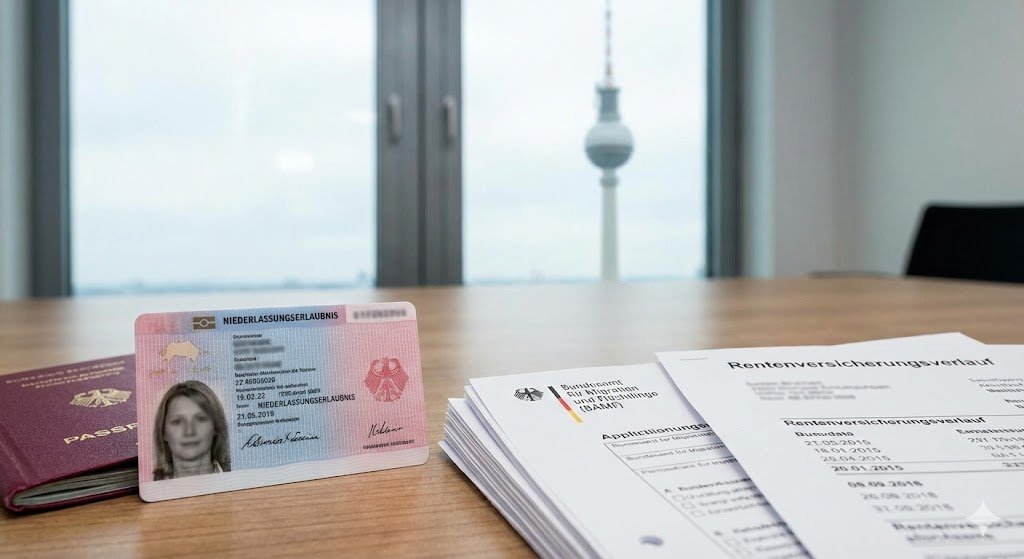

- Obtaining the Settlement Permit (known in German as Niederlassungserlaubnis) is the most significant milestone for any expatriate in Germany. It grants you the right to live in the country indefinitely, change jobs without permission, and eventually apply for citizenship. Unlike the temporary Residence Permit (Aufenthaltstitel), this status is secure—it does not expire even if you lose your job.
However, the path to Permanent Residence (PR) is not one-size-fits-all. The rules in 2025 have become more specific, with different “fast tracks” for skilled workers and graduates. This comprehensive guide covers every category, requirement, cost, and document you need to secure your future in Germany, sourced directly from the Federal Office for Migration and Refugees (BAMF).
1. The PR Categories: Which Path is Yours?
Before you apply, you must identify which “track” you qualify for. The waiting time varies drastically between these groups.
The “Standard” Route (5 Years)
This is the default path for anyone who does not fit into a specialized category.
Duration: You must have lived in Germany for 5 years.
Pension: You need 60 months of contributions to the Statutory Pension Insurance (Deutsche Rentenversicherung).
Language: Level B1 German is mandatory.
Integration: You must pass the Life in Germany Test (Leben in Deutschland).
The “Skilled Worker” Fast-Track (3 Years)
Under the new Skilled Immigration Act, professionals with recognized vocational training or university degrees benefit from reduced wait times.
Duration: Reduced to 3 years (formerly 4).
Pension: 36 months of contributions.
Language: Level B1 German.
Condition: You must be employed in a job that matches your qualification as a Qualified Professional.
The “EU Blue Card” Fast-Track (21–27 Months)
This remains the fastest route for high earners.
Option A: Apply after 27 months if you have Level A1 German.
Option B: Apply after 21 months if you have Level B1 German.
Pension: You must have paid contributions for the corresponding period (21 or 27 months).
Source: Read the official EU Blue Card PR rules here.
German University Graduates (2 Years)
If you graduated from a German university, the government wants to keep you.
Duration: You can apply just 2 years after graduation.
Pension: Only 24 months of contributions are needed.
Language: B1 is required (often waived if your degree was taught in German).
Self-Employed & Freelancers (3 Years)
Duration: 3 years.
Condition: You must prove your business is financially healthy and you can support your family without state aid. This is strictly checked by the tax authorities. - Read More:-
Poland Secures Exemption from EU Relocation Quotas: A Victory for ‘Solidarity in Fact’ - How to apply Asylum/International Protection Process in Italy
- Spain: How to take Legal Residency via the Arraigo Program
- Spain Embracing Migration to Secure Economic Future
- Europe to Launch its Digital Border Control System
2. The Requirements: A to Z Details
Regardless of your category, you must satisfy these core requirements. If any of these are missing, your application will be rejected immediately.
A. Housing (Square Meters Rule)
You cannot get PR if your apartment is too small. The immigration office (Ausländerbehörde) enforces strict rules on living space to prevent overcrowding.
The Formula: You generally need 12 square meters of living space for every person aged 6+, and 10 square meters for children under 6.
Example: A family of three (two adults, one 8-year-old) needs an apartment of at least 36 sqm.
Proof: You must submit a current Rental Contract (Mietvertrag) and a landlord confirmation (Wohnungsgeberbestätigung).
B. Financial Security (Livelihood)
There is no fixed salary number like “€50,000” for PR. Instead, the test is Secure Livelihood (Lebensunterhaltssicherung).
Calculation: Your net income must cover rent, health insurance, and daily costs for your entire household.
Employment Status: You cannot be in your probation period (Probezeit). You must have a permanent contract.
C. Pension Contributions (Rentenverlauf)
This is the most critical document. You must prove you have paid into the social security system.
Action: Contact the Deutsche Rentenversicherung and ask for a “Versicherungsverlauf” (Insurance History). This document lists exactly how many months you have paid.
3. Application Process: How and Where to Apply
The application process is decentralized in Germany, meaning it depends on the city where you live.
Step 1: Locate your Authority You must apply at your local Foreigners Authority (Ausländerbehörde). You can find the specific office responsible for your address using the BAMF-NAvI Tool.
Step 2: Submit the Application
Online: Major cities like Berlin, Munich, and Frankfurt now allow you to submit the application form and upload PDFs online.
Email/Post: In smaller towns, you may need to email the documents or mail paper copies to get an appointment.
Step 3: The Appointment Once your documents are reviewed (which can take 3–6 months), you will be invited for an in-person interview. You will provide your fingerprints and pay the fee.
Step 4: Pickup After approval, it takes about 4–6 weeks for the physical card to be printed by the Federal Printing Office (Bundesdruckerei). You will receive a PIN letter by mail, followed by an invitation to pick up your card.
4. Checklist of Required Documents
Prepare these documents before you apply. Missing one document will delay your case by months.
Application Form: Completed and signed (Form Antrag auf Erteilung der Niederlassungserlaubnis).
Valid Passport: Must not expire within the next 6-12 months.
Biometric Photo: Recent (not older than 6 months), 35mm x 45mm.
Proof of Income:
Last 3 months’ salary slips.
Employer’s certificate (Arbeitgeberbescheinigung) confirming you are still employed and not on probation.
Pension Statement: The Versicherungsverlauf from the Pension Insurance.
Health Insurance: Confirmation of membership (Mitgliedsbescheinigung) from your provider (e.g., TK, AOK, Barmer).
Housing Proof: Rental contract (Mietvertrag) + Proof of rent payment (bank statement) + Landlord confirmation.
Language Certificate: Official certificate (Telc, Goethe, TestDaF) for B1 or A1 level.
Integration Test: Certificate for the Integration Course if applicable.
5. Fees for 2025
The cost of the Permanent Residence permit is set by federal law, but minor variations exist depending on your status.
| Applicant Category | Fee (Approximate) |
| Standard Application (Skilled Worker) | €113.00 |
| Self-Employed | €124.00 |
| Turkish Nationals (Special Law) | €22.80 (Reduced fee) |
| Minors (Children) | €55.00 |
| Re-issuing card (lost/new passport) | €67.00 |
Note: Fees are usually paid by Girocard (EC Card) at the appointment. Cash is often not accepted.
- Frequently Asked Questions (FAQ)
Question: Can I count my student years towards the 5-year requirement?
Answer: Yes, but only half. If you studied for 2 years, it counts as 1 year towards the 5-year requirement. However, if you graduate from a German university, you switch to the special “Graduate” track where you only need 2 years of post-grad work total.
Question: Can I leave Germany for more than 6 months with a PR?
Answer: Generally, no. If you leave Germany for more than 6 months, your PR expires automatically. However, there are exceptions: If you are over 60, or if you have lived in Germany for at least 15 years and can support yourself, you may apply for a specific permission to stay away longer. Always ask the Ausländerbehörde before you leave.
Question: Do I need a B1 certificate if I speak excellent German?
Answer: Usually, yes. The bureaucracy requires paper proof. However, if you have a German university degree (taught in German) or completed vocational training in Germany, the certificate is waived because your degree proves your proficiency.
Question: Is the “Life in Germany” test mandatory for everyone?
Answer: It is mandatory for the Standard and Skilled Worker routes. It is often waived for graduates of German universities or those with a German school leaving certificate (Abitur), as they have already studied the German social system.
Question: What happens if I lose my job after getting PR?
Answer: Nothing. That is the main benefit of Permanent Residence. Your right to stay in Germany is no longer tied to your employer. You can be unemployed, search for a job, or start a business without losing your visa, as long as you do not leave Germany for too long.