
France remains one of the most sought-after citizenships in the world. A French passport not only gives you access to the European Union but also allows you to pass your nationality down to your children. However, the process of “Naturalisation” is famous for its bureaucracy.
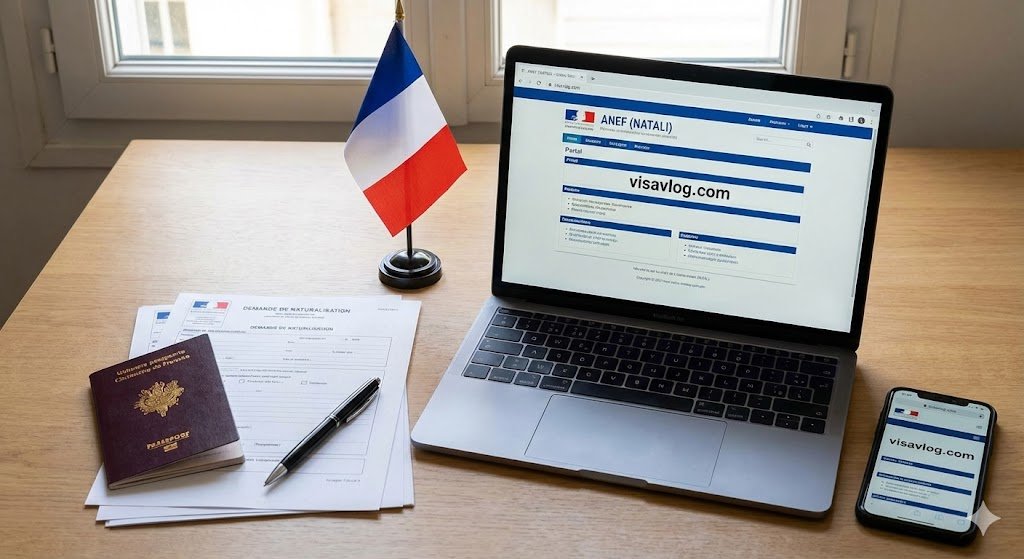
In 2026, the process has become largely digital through the ANEF (NATALI) platform, but the criteria for “professional insertion” remain strict. Whether you are a foreign worker on a CDI contract or an international student finishing a Masters degree, this guide explains exactly how to get the “Blue, White, and Red” passport.
1. The Two Main Paths to Citizenship
Before you apply, you must know which timeline applies to you.
Path A: The Standard Route (5 Years)
- Who: Workers, business owners, and residents.
- Requirement: You must have lived in France legally and continuously for 5 years.
- Condition: You must show that France is your “center of material interests” (i.e., your job and family are here, not abroad).
Path B: The “Masters” Fast Track (2 Years)
- Who: International students who have graduated from a French higher education institution.
- Requirement: If you obtained a Masters Degree (Bac+5) or a higher qualification (like a PhD) from a French university, the residency requirement is reduced from 5 years to 2 years.
- Crucial Note: This reduction is not automatic citizenship. You still need to prove you have a job and stable income. It just means you can apply earlier.
2. A-to-Z Eligibility Requirements (2026)
To be approved by the Prefecture, you must meet all the following criteria.
A. Financial Stability (Resources)
This is the #1 reason for rejection.
- The Rule: You must have “Stable and Sufficient Resources” (Ressources stables et suffisantes).
- The Contract: The Prefecture prefers a CDI (Permanent Contract). While it is possible to get citizenship with a CDD (Fixed-Term) or as a Freelancer, it is much harder. You must show 3 years of steady income if you are a freelancer.
- The Amount: Generally, you should earn at least the SMIC (Minimum Wage, approx. €1,400 net/month in 2026) or higher. If you earn less or rely on social benefits (RSA), your application will likely be adjourned.
- Read More:-
- How to Switch from Student Visa to Skilled Worker Visa in UK
- Asylum Seekers to Face 20-Year Wait for UK Settlement
- UK to Allow High Earners New Faster Path to Residency
- The UK Home Office’s New Asylum Model
- UK Visitor Visa: A Comprehensive Guide
B. Housing Requirements
You cannot bring your family to a tiny studio.
- The Rule: You must have “decent accommodation” appropriate for your family size.
- Calculation: If you are a couple, you typically need at least 16m² for the two of you, plus 9m² for each additional child.
- Proof: You need to provide your lease agreement (Bail de location) and the last 3 rent receipts (Quittances de loyer).
C. Language Proficiency (B1 Level)
You must speak French.
- The Level: You need to prove B1 Level in both Oral (Speaking/Listening) and Written (Reading/Writing).
- The Test: You must take the TCF-IRN or TEF exam unless you are exempt.
- Exemption: If you have a French diploma (Brevet, CAP, Bachelors, or Masters), you do not need to take the language test. Your degree is your proof.
D. Tax Compliance
You must prove you are a good citizen.
- P237 Form: You must show a tax certificate (Bordereau de situation fiscale) proving you owe no money to the French tax office.
- Declarations: You must submit your Avis d’impôt (Tax Notices) for the last 3 years.
3. Step-by-Step Application Process
In 2026, most Prefectures have switched to the online system.
Step 1: Buy the Tax Stamp
- The fee for French citizenship is €55.
- You must buy a digital “Timbre Fiscal” online at the official tax website.
Step 2: Submit on ANEF (NATALI)
- Go to the Official Administration Platform (ANEF).
- Create an account with your residence permit number.
- Upload all documents (Passport, Birth Certificate, Housing proof, Job contract, Payslips).
- Birth Certificate: Must be translated into French by a “Sworn Translator” (Traducteur Assermenté).
Step 3: The Interview (Entretien d’assimilation)
- Once your file is processed (this can take 6–18 months depending on the city), you will be summoned to the Prefecture for an interview.
- The Test: The agent will ask you questions about French history, values, and society.
- Examples: “What is Laïcité?”, “Name 3 French rivers,” “Who is the current Prime Minister?”
- Preparation: You must study the Livret du Citoyen (Citizen’s Booklet).
Step 4: The Decision
- After the interview, the file goes to the Ministry of Interior (SDANF).
- If approved, your name will appear in the Official Journal (JO). You are now French!
4. Family Citizenship Rules
- Spouse: Being married to a French person does not make you French automatically. You can apply by “Declaration” after 4 years of marriage (if you lived in France) or 5 years (if lived abroad).
- Children:
- Born in France to foreign parents: They generally acquire citizenship at age 18 (or 13/16 upon request) if they have lived in France for 5 years.
- Born abroad: They can be naturalized with you if they live with you and are mentioned in your application.
5. Summary Table
| Category | Residency Time | Key Requirement | Application Fee |
| Standard Worker | 5 Years | Stable Job (CDI) | €55 |
| Masters Graduate | 2 Years | French Degree + Job | €55 |
| Spouse of French | 4 Years | Marriage Continuity | €55 |