
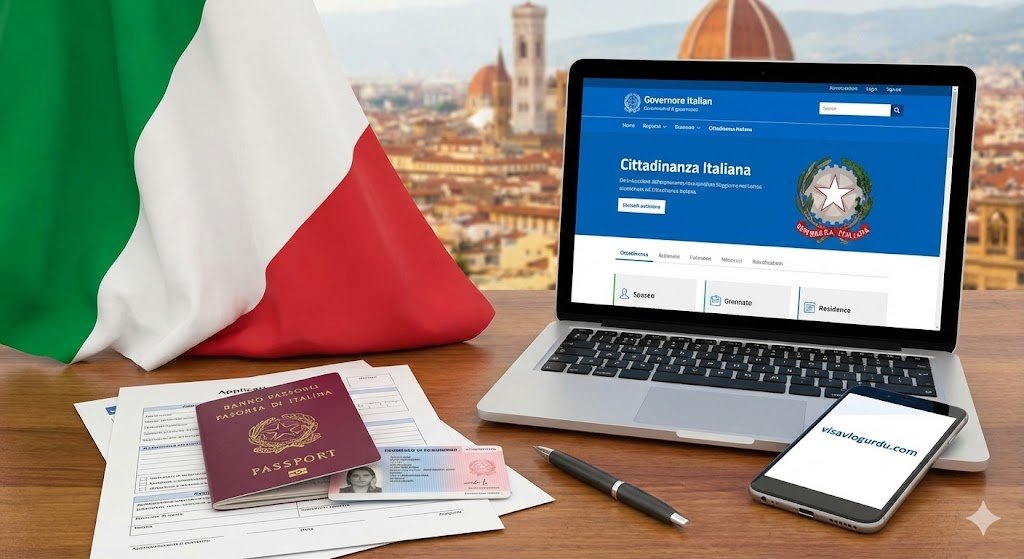

Italy possesses one of the most powerful passports in the world, ranking consistently in the top tier of the Henley Passport Index. For non-EU nationals, holding a Passaporto Italiano grants unrestricted rights to live, work, and retire anywhere across the 27 European Union member states. However, obtaining this privilege is a marathon, not a sprint. Unlike France (which requires 5 years) or Spain (which allows 2 years for Ibero-American nationals), Italy maintains one of the strictest residency requirements in Europe: a solid 10 years for non-EU citizens.
As we move into 2026, the landscape for Italian citizenship (Cittadinanza) has evolved. While the Italy New Immigration for 2026 quota has opened the doors for over 150,000 new workers, the path from “Work Permit” to “Citizenship” remains heavily regulated. The Ministry of Interior (Ministero dell’Interno) has fully digitized the application process via the ALI Portal, but they have also introduced stricter checks on income continuity and integration. Furthermore, a significant fee increase has been implemented for those applying via “Bloodline” (Jure Sanguinis), doubling the cost to €600.
Whether you are a long-term worker who arrived on an Italian Work Visa or a student who settled after International Student Enrollment, this comprehensive A-to-Z guide explains exactly how to navigate the bureaucracy in 2026.
1. The Three Main Paths to Citizenship
Your eligibility timeline depends entirely on your status and connection to Italy.
Path A: Citizenship by Residency (Naturalization) This is the most common route for the vast majority of Italy’s 5.4 million foreign residents.
- Non-EU Citizens: You must have resided in Italy legally and continuously for 10 years. This applies to citizens of India, Pakistan, USA, UK, Canada, etc.
- EU Citizens: If you are a citizen of France, Romania, or Germany, you only need 4 years of residency.
- Refugees & Stateless Persons: If you have been granted Asylum or International Protection, the requirement is reduced to 5 years. However, this does not apply to “Subsidiary Protection” or “Special Protection” holders, who often still face the 10-year rule.
- Adult Adoptees: If you were adopted by an Italian citizen as an adult, you need 5 years of residency.
Path B: Citizenship by Marriage This route is faster but requires genuine integration.
- Residing in Italy: You can apply after 2 years of legal residence after marriage. If you have children (biological or adopted), this is halved to 1 year.
- Residing Abroad: If you live outside Italy, you can apply after 3 years of marriage (halved to 1.5 years with children).
- Crucial Condition: The marriage must still be valid (no separation or divorce) at the time of the citizenship oath.
Path C: Citizenship by Descent (Jure Sanguinis)
- Who: For those with an Italian ancestor (parent, grandparent, great-grandparent) who did not renounce their citizenship before the next generation was born.
- 2026 Fee Hike: The application fee for this specific category has officially increased from €300 to €600 per adult applicant to cover the administrative burden on courts and consulates.
- Read More:-
- Canada Announces Immediate Cap on Spousal Open Work Permits (Breaking)
- Canada Express Entry 2025: Category-Based Draws Explained
- Canada Proposes Massive 65% Cut to Study Permits
- Canada’s Brain Drain: Why Highly Skilled Immigrants are Leaving
- New Fast-Track PR for Temporary Workers in Canada
2. The 2026 Requirements: A Detailed Breakdown
To ensure your application is not rejected (or “inadmissible”), you must meet every single one of these criteria.
A. The “CUD” Income Requirement (Economic Sustainability)
Italy requires that new citizens be economically independent. You cannot be solely dependent on social welfare.
- The Three-Year Rule: You must prove you met the minimum income threshold for each of the 3 years immediately preceding your application.
- The Thresholds (2026):
- Single Applicant: €8,263.31 per year.
- Applicant + Dependent Spouse: €11,362.05.
- Per Dependent Child: Add €516.00.
- Accepted Proof: You must submit your CUD (Certificazione Unica) if you are an employee, or Modello 730/Unico if you are self-employed.
- Common Mistake: Many applicants apply with only 2 years of CUDs. This leads to immediate rejection. You must wait for the 3rd tax return to be officially filed.
B. Continuous Residency (Residenza Anagrafica)
This is where many fail. Holding a valid permit (Permesso di Soggiorno) is not enough; you must be registered at the City Hall (Comune).
- The Gap Rule: If you ever deregistered your address (cancelled from the Anagrafe) or moved abroad for more than 6 months, your 10-year clock resets to zero.
- Verification: Before applying, go to your Comune and ask for a Certificato Storico di Residenza. This document will show your entire history. Ensure there are no “holes” in the timeline.
C. Language Proficiency (B1 Level)
Since the Salvini Decree, speaking Italian is mandatory.
- The Level: B1 Level (Intermediate) of the CEFR framework.
- Authorized Exams: You cannot just have a chat with the officer. You must pass a formal written and oral exam from one of the four approved bodies: Dante Alighieri (PLIDA), University of Siena (CILS), University of Perugia (CELI), or Roma Tre.
- The “B1 Cittadinanza” Test: This is a cheaper, shorter version of the exam (approx €100). However, if you fail one section (e.g., writing), you fail the whole test.
- Exemptions:
- Those holding the old EU Long-Term Residence Permit (issued before 2011 with “Soggiornante di Lungo Periodo”).
- Those who graduated from an Italian school or university.
D. Clean Criminal Record
You must provide a Police Clearance Certificate (Penal Certificate) from:
- Your country of origin.
- Any other country where you lived after age 14.
- Validity: These certificates expire after 6 months. Do not get them too early.
- Translation: They must be translated into Italian and legalized (or Apostilled) by the Italian Embassy in that country.
3. Step-by-Step Application Process in 2026
Step 1: Digital Identity (SPID) Paper applications are obsolete. You must obtain a SPID (Public Digital Identity System) level 2. This is your key to accessing the ALI portal.
Step 2: The ALI Portal Submission
- Log in to the Ministry of Interior Citizenship Portal.
- Fill out the online form (Modello B for Residency, Modello AE for Marriage).
- Upload high-quality PDF scans of your Passport, Birth Certificate (Translated/Legalized), Criminal Record (Translated/Legalized), CUDs, and Proof of Payment.
Step 3: Payments
- Application Fee: €250. This must be paid via PagoPA inside the portal.
- Revenue Stamp: You need a €16 Marca da Bollo (buy at any Tabacchi shop) and enter the serial number in the online form.
Step 4: The Phases (K10/K10C) Once submitted, you will get a protocol number (K10/K10C). You can track your status:
- Phase 1-2: Checks by the Prefecture and Police headquarters.
- Phase 3-4: Security checks by Intelligence services.
- Phase 5-6: Final decision by the President of the Republic or Ministry.
- Phase 7: Decree signed.
Step 5: The Oath Once the decree is signed, you have 6 months to take the Oath of Allegiance at your local municipality. If you miss this deadline, the decree is void, and you must restart the 10-year process.
4. Dual Citizenship Rules: India vs. Pakistan
Italy recognizes Dual Citizenship. You are not required to renounce your original nationality to become Italian.
- For Pakistanis/Americans/British: You can keep both passports.
- For Indians: The Constitution of India does not allow dual citizenship. Once you become Italian, you must surrender your Indian passport at the Indian Embassy. You can then apply for an OCI Card (Overseas Citizen of India), which grants you lifetime visa-free travel to India, but not political rights.