
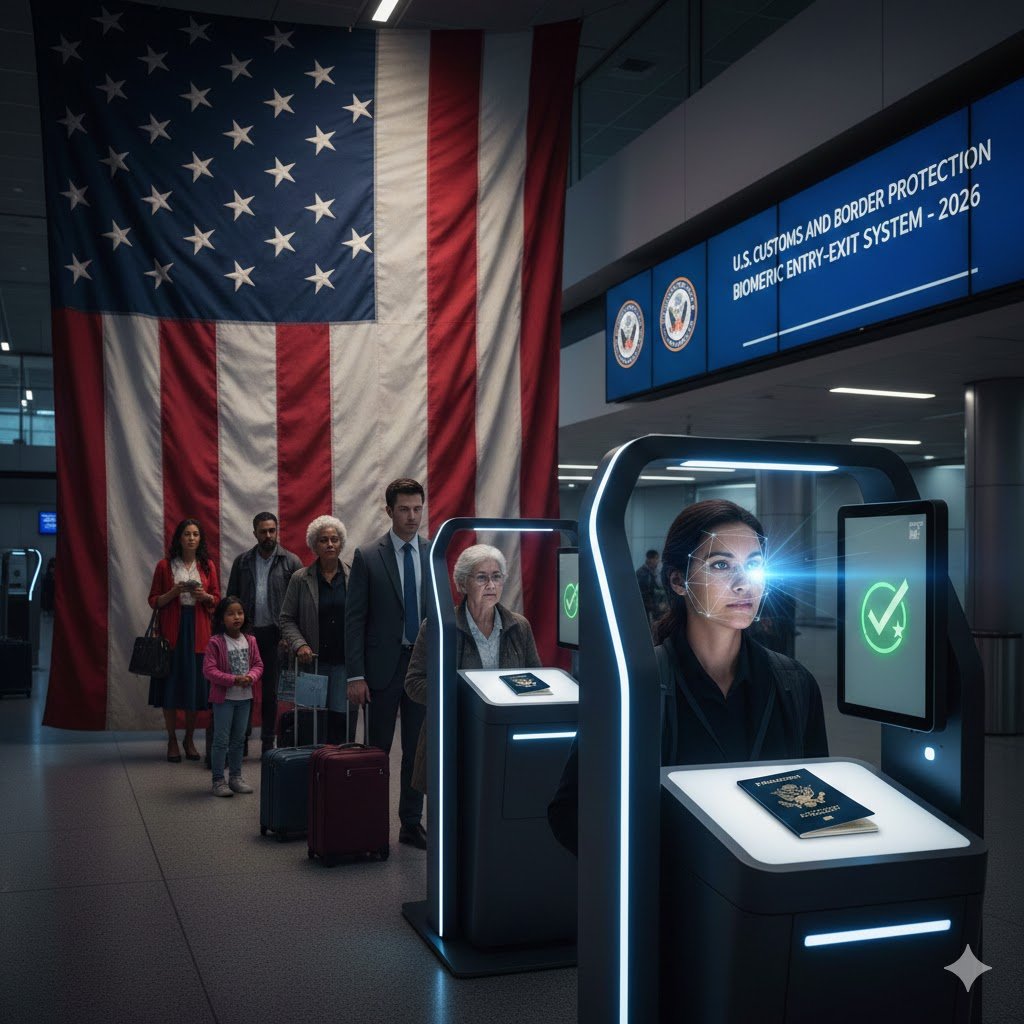

Starting December 26, 2025, the U.S. has launched a mandatory biometric entry-exit system for all non-citizens, including Green Card holders. Learn how these new facial recognition rules at airports and land borders affect your travel in 2026.
As the calendar turns to 2026, international travelers must prepare for a fundamentally different experience at the United States border. Following the official implementation of the Final Rule on December 26, 2025, the Department of Homeland Security (DHS) has transitioned from trial phases to a nationwide, mandatory Biometric Entry-Exit System. This article explores the mechanics of this shift, its impact on various visa holders, and the broader global context of tightening immigration controls.
The Nationwide Rollout: A New Era of Border Security
The implementation of the nationwide biometric mandate represents the most significant overhaul of U.S. border procedures since the early 2000s. Unlike previous years, where facial recognition was primarily seen at major international airports, the new 2026 standards apply to all airports, seaports, and land border crossings.
For those navigating the future of North American travel, the most striking change is the removal of long-standing exemptions. Previously, children under 14 and seniors over 79 were often bypassed; now, the mandate includes all age groups and all non-U.S. citizens, including Lawful Permanent Residents (Green Card holders) and most Canadian visitors.
- Read More:
- Japan eVISA System: Full List of Eligible Countries, Rules for Pakistan, India, EU & USA (2026 Guide)
- Trump Expands Travel Ban to 39 Countries: The Complete List & Official Reasons
- Sweden Proposes Major Tightening of Family Immigration Rules: Income Requirements Set to Soar
- Sweden’s Radical 2027 Proposal: Revoking Permanent Residence for Asylum Seekers (Analysis)
- Pakistan Reports Historic 47% Decline in Illegal Immigration to Europe Amid Crackdown
How the Traveler Verification Service (TVS) Works
The backbone of this system is the Traveler Verification Service (TVS). This cloud-based technology uses a “1-to-n” matching algorithm. When a traveler approaches a CBP camera, a high-resolution image is captured and compared against a gallery of photos the government already possesses—such as those from a U.S. B-1/B-2 visitor visa application, a passport, or previous entry records.
This process is designed to be “simplified” and “touchless,” typically taking less than 20 seconds. However, travelers should be aware of the challenges of being an immigrant in the current climate. The system is not just about speed; it is about creating a perfect digital record of every person’s entry and, crucially, their exit from the country.
Tracking Overstays and Enhancing Vetting
One of the primary drivers behind the 2026 biometric expansion is the ability to track visa overstays with absolute precision. Historically, the U.S. had a robust system for recording entry but a “patchy” system for recording exit. By mandating biometrics at departure gates, the DHS can now instantly identify individuals who have exceeded their authorized stay.
Heightened Scrutiny for High-Risk Countries
The rollout coincides with a period of intense vetting. As of early 2026, there is a specific focus on citizens from 19 designated countries, including Afghanistan, Iran, and Venezuela. If you are a national of these countries, expect even more rigorous checks. This follows the recent news that the US has stopped all Afghan immigrants indefinitely following security concerns.
Furthermore, the vetting process now extends deeply into a traveler’s digital life. Applicants are often required to undergo social media auditing as part of their visa interview process, and the biometric data captured at the border is the final “key” that links a physical person to their digital and background records.
2026 Green Card Traveler’s Compliance Checklist
Because the new biometric entry-exit system now tracks the exact duration of your time outside the U.S., “maintaining residency” has become a matter of digital record rather than officer discretion.
1. Pre-Departure: Documents and Digital Health
- Verify I-551 Validity: Ensure your Green Card is not expired. Even with a valid card, if the photo is significantly aged or damaged, it may fail the biometric match, leading to a detailed border questioning session.
- Apply for a Re-entry Permit (I-131): If you plan to be outside the U.S. for more than six months, a Re-entry Permit is now more critical than ever. The biometric exit record will flag your departure date the moment you scan your face at the gate.
- Social Media Review: CBP vetting now often includes digital footprints. Perform a social media audit to ensure your public profiles do not contradict your residency claims (e.g., listing a foreign city as your “permanent home”).
2. At the Airport/Port: The Biometric Gate
- Prepare for Facial Capture: When approaching the kiosk, remove hats, glasses, and masks. The camera must match your live image against the “gallery” created from your previous permanent residence card application.
- Expect Exit Scans: Unlike previous years, you will now be scanned before boarding your outbound flight. This confirms your departure and starts the clock on your time abroad in the DHS database.
- No Opt-Out for LPRs: Remember that while U.S. citizens can opt out of facial recognition, Green Card holders cannot. Refusal to cooperate can result in fines or being flagged for “abandonment of residency.”
3. Post-Travel: Verification
- Check Your I-94 Record: After returning, log into the CBP I-94 portal to ensure your entry and exit dates were recorded correctly. Biometric “mismatches” can occasionally occur; if they do, you must file a redress inquiry immediately to correct your travel history.
Why 2026 is Different: The End of the “Gray Area”
For years, some Green Card holders maintained their status by making “touch-and-go” visits—returning to the U.S. once every six months for a few days to reset the clock. In 2026, the Biometric Entry-Exit System makes this strategy highly risky.
Because the system tracks every second of your stay, CBP officers now have a dashboard that shows exactly how many days you have spent in the U.S. versus abroad over the last five years. If your biometric profile shows you are spending more time outside the country than inside, you may face an immediate “Residency Monitoring” interview at the port of entry.
Heightened Scrutiny for the “19-Country List”
If you are a Green Card holder originally from one of the 19 countries on the expanded travel ban list, be prepared for “Secondary Inspection” as a routine part of your travel. The DHS has ordered a full-scale review of Green Cards issued to nationals from these regions since 2021. Always carry secondary proof of your U.S. ties, such as:
- Recent U.S. tax returns (Form 1040).
- Active U.S. bank statements and utility bills.
- Proof of U.S. employment or property ownership.
Privacy, Data Retention, and the Global Shift
The privacy implications of the 2026 system are substantial. For non-U.S. citizens, the facial images captured are stored in the DHS Biometric Identity Management System for up to 75 years. This long-term retention allows the government to track a traveler’s entire lifecycle of interaction with the United States.
Comparison with Global Trends
The U.S. is not alone in this digital transformation. Many travelers are comparing these changes to other major regions:
- Europe: The EU has launched its own digital Entry/Exit System (EES), mirroring the U.S. approach.
- United Kingdom: The UK is moving toward a complete transition to e-visas by 2026, eliminating physical BRP cards in favor of biometric digital records.
While these systems are promoted as tools for efficiency, they also reflect a global trend toward more restrictive and monitored borders. For example, Germany has tightened citizenship rules, and many nations are shifting away from “open” models toward highly vetted, skill-based immigration.
What Travelers Should Prepare For in 2026
If you are planning a trip to the U.S. this year, the following steps are essential to ensure a smooth crossing:
- Arrive Early: Despite the technology’s speed, the “Final Rule” implementation may cause congestion at land borders and smaller airports that are still adjusting to the hardware requirements.
- Verify Documents: Ensure your ESTA travel authorization or visa is current. Note that CBP is proposing even broader data collection for ESTA, including live “selfies” during the application process.
- Understand the Opt-Out: Only U.S. citizens have the legal right to opt out of facial recognition at the border. If you are a U.S. citizen, you can request a manual passport check. Non-citizens, including Green Card holders, must comply with the biometric capture or face denial of entry/boarding.
- Expect Questioning: The biometric check is often followed by a brief interview. Officers now have instant access to your immigration case status and any potential red flags from your social media or previous travel history.
The 2026 biometric border is no longer a concept of the future; it is a functioning reality. As the U.S. continues to integrate AI and facial comparison technology into its national security framework, travelers must stay informed and compliant to navigate these high-tech gates successfully.
Frequently Asked Questions