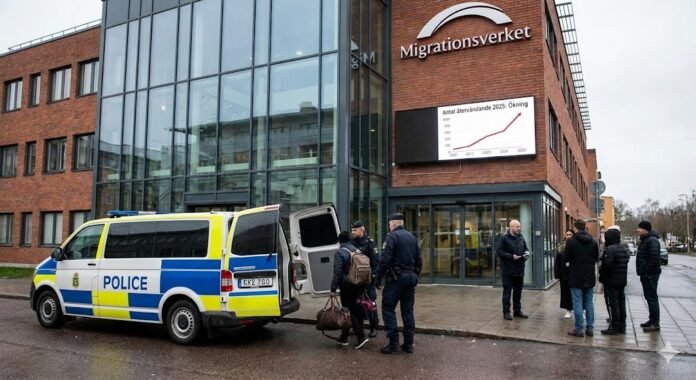


As we approach 2026, the Swedish government is firmly proceeding with what it describes as a historic restructuring of its migration policy. In a significant move announced in December 2025, the government has unveiled a comprehensive proposal that targets foreign citizens who have been ordered to leave the country but cannot be immediately deported due to temporary obstacles.
This new legislative framework, scheduled to enter into force on May 1, 2026, marks a decisive shift away from granting temporary residence permits to individuals who pose security threats or have criminal convictions. Instead, a new system of “postponed enforcement” will be introduced, stripping away many of the rights and privileges currently available to this group.
For observers of Swedish migration law, this proposal represents one of the most tangible steps yet in the government’s effort to prioritize national security and effective return migration over the integration of non-deportable individuals.
The Current System: Why the Government Wants Change
To understand the magnitude of the 2026 migration rules, it is essential to look at how the current system operates. Under existing regulations, foreign citizens who receive a deportation order—whether due to criminal convictions, security risks, or rejected asylum claims—are legally required to leave Sweden. However, in reality, authorities often face “impediments to enforcement” (verkställighetshinder).
- Read more:-
- How to Get Swedish Citizenship: The 2026 Guide
- Why Getting Permanent Residence in Sweden is Becoming Harder
- How to Become a German Citizen in 2026: The Ultimate Guide
- How to Bring Your Family to Germany in 2026: Family Reunion Visa Guide
These impediments can be practical or legal. For example, the receiving country might refuse to accept the individual, or there might be a temporary risk of torture or persecution that prevents forced removal under international law. Currently, when such temporary obstacles arise, the standard practice in Sweden has been to grant these individuals a temporary residence permit.
This practice has long been a point of contention for the current government. By granting a residence permit, even a temporary one, the Swedish state effectively restores many of the individual’s rights. These people regain access to the Swedish labor market, the full spectrum of social welfare benefits, and the freedom to travel within the European Union.
According to Migration Minister Johan Forssell, this system sends the wrong signal. In the government’s view, if a person has committed a crime or poses a threat to national security, they should not be rewarded with a permit that allows them to live “as usual” in Sweden simply because their deportation is temporarily stalled.
The New Proposal: Postponed Enforcement Instead of Permits
The core of the new proposal, which has been referred to the Legislative Council (Lagrådet), is to abolish the automatic granting of residence permits in these situations. Instead, starting in May 2026, the Swedish Migration Agency will utilize a mechanism known as postponed enforcement.
This legal distinction is crucial. By “postponing enforcement” rather than issuing a permit, the individual remains legally classified as someone who must leave the country. They are not residents; they are merely present because they cannot yet be removed.
This change allows the government to strip away the associated rights that come with residence status. The primary goal is to ensure that these individuals do not integrate into Swedish society and to maintain a high level of pressure on them to cooperate with their eventual departure.
Strict Restrictions on Movement and Welfare
The proposed legislation introduces a series of severe restrictions aimed at controlling the whereabouts and activities of non-deportable individuals. The government has made it clear that these measures are designed to protect Swedish society and facilitate return migration.
1. Designated Residence and Reporting Duties
Under the new rules, affected foreign citizens will no longer have the freedom to choose where they live. The proposal states that the foreigner shall be allocated a specific place to live in one of the Swedish Migration Board’s accommodation facilities.
Living in this designated facility will be a prerequisite for receiving any form of financial assistance. Furthermore, these individuals may be prohibited from leaving a specific geographic area and will be required to report regularly to the police or the Migration Agency.
2. Criminal Penalties for Non-Compliance
The government is introducing teeth to these regulations. Anyone violating the reporting obligation or the prohibition on leaving their designated area faces serious consequences. The proposal includes a provision where violations can lead to a sentence of imprisonment for a maximum of one year. This effectively criminalizes non-compliance with the administrative controls placed on non-deportable individuals.
3. Restricted Access to Welfare and Work
Perhaps the most impactful change for the daily lives of those affected is the restriction on economic rights. The proposal explicitly limits the foreigner’s right to work. Without a residence permit, they will generally not be authorized to enter the labor market.
Additionally, access to Swedish welfare benefits will be cut to a bare minimum. Instead of the broad social support available to residents, these individuals will likely only receive basic subsistence support tied to their residence at the Migration Agency facility. The aim, as articulated by the government parties, is to ensure that convicted criminals and security threats cannot “live on Swedish benefits.”
Political Consensus Among the Tidö Parties
This proposal is a product of the collaboration between the governing parties and the Sweden Democrats, often referred to as the Tidö parties. The rhetoric surrounding this announcement reflects a unified stance on tightening migration policy.
Ludvig Aspling, the migration policy spokesperson for the Sweden Democrats, described the current system as “completely unreasonable,” noting that it allows people sentenced to deportation to receive income support. The new system, he argues, will grant a “minimum of rights and freedoms” with the ultimate goal of ensuring these individuals leave Sweden as soon as possible.
Similarly, Ingemar Kihlström of the Christian Democrats emphasized that this is part of the “largest restructuring of legal policy in modern history.” The focus is heavily on control—ensuring that authorities know where these individuals are and that they are not free to roam or re-offend while waiting for deportation.
Patrik Karlson of the Liberals also supported the move, stating that granting residence permits to those with deportation orders risks “undermining trust in the entire system.”
Broader Context: 2026 as a Year of Migration Reform
This proposal does not exist in a vacuum. It is part of a broader wave of reforms scheduled to take effect in 2026.
For instance, the Swedish Migration Agency has already announced that starting January 1, 2026, there will be significant increases in repatriation grants. These grants are designed to incentivize voluntary return for those who have valid residence permits but wish to leave. Conversely, the proposal discussed here targets those without a right to stay, ensuring that the “carrot” of voluntary return is matched by the “stick” of stricter enforcement for those who refuse to leave or have been ordered expelled.
Furthermore, these changes align with the government’s instructions to the Swedish Police Authority and the Swedish Security Service to intensify their work on internal controls and the enforcement of expulsion orders. The new powers to restrict residence and mandate reporting are direct tools to assist these agencies in their duties.
Conclusion: What This Means for the Future
The introduction of these rules on May 1, 2026, will fundamentally alter the landscape for individuals with deportation orders in Sweden. The era where a “temporary impediment” to deportation led to a normalized life in Sweden is coming to an end.
For the government, this is a necessary step to restore the credibility of the migration system and prioritize the safety of Swedish citizens. For the individuals affected—specifically those deemed security threats or criminals—life in Sweden will become significantly more restricted, controlled, and financially precarious.
As we move closer to 2026, it is vital for all stakeholders to stay informed about these legislative changes. The government’s message is clear: a deportation order is final, and obstacles to enforcement will no longer be a gateway to residency.