
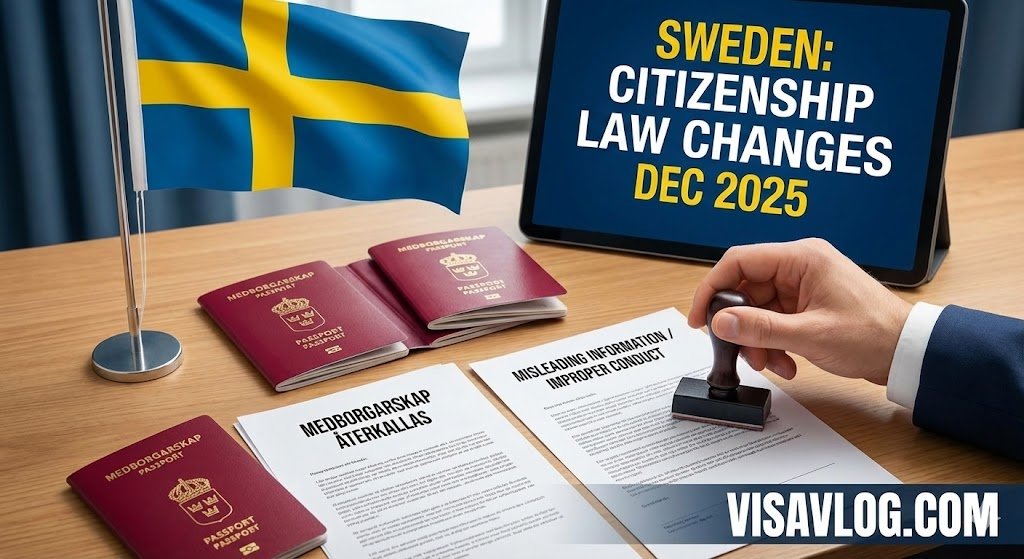

Sweden has introduced a historic bill in December 2025 to revoke citizenship from individuals who provided false information or engaged in improper conduct. Learn about the new constitutional changes, the “Tidö Agreement” impact, and the 2027 implementation plan.
For decades, Swedish citizenship was considered permanent and untouchable. Once you received your red passport, it was yours for life. That era is officially ending.
In a landmark move that shifts the country’s entire migration landscape, the Swedish government officially introduced a bill on December 8, 2025, outlining the legal framework to revoke Swedish citizenship from dual nationals. This proposal, derived from the controversial Tidö Agreement, targets individuals who acquired their status through lies, fraud, or what the government terms “improper conduct.”
This comes on top of other recent tightening measures, such as the strict new rules for deportation orders and increased enforcement efforts. If you are a foreigner living in Sweden or planning to apply for a passport, this is the most critical update of the decade. The rules of belonging in Sweden are being rewritten.
- Read More:
- How to Audit Your Social Media for US Visa Interviews: The 2026 Survival Guide
- Your Complete Guide to Getting Spanish Nationality: The 2026 Roadmap
- US H-1B & H-4 Visa Appointments Cancelled for Mandatory Social Media Vetting
- The End of the BRP Card: UK’s Complete Transition to E-Visas by 2026
- How to Convert a Student Permit to a Work Permit in Italy in 2026
The New Bill: Grounds for Revocation
According to the proposal published by the Government of Sweden (Regeringen), the state will soon have the power to strip citizenship in three specific scenarios. This applies primarily to those with dual citizenship (to avoid leaving anyone stateless).
1. Incorrect or Misleading Information This is the most widespread risk. If authorities discover that you lied on your original residency or citizenship application—even years later—your citizenship can be cancelled.
- Examples: Faking your identity, hiding a criminal record from your home country, or lying about your grounds for asylum (e.g., claiming persecution when there was none).
- The government emphasized that “citizenship obtained on erroneous grounds” is void.
2. Improper Conduct (Systemic Threat) This is a new and broad legal term. It refers to individuals who act in a way that threatens Sweden’s “vital interests.”
- This targets organized crime figures, gang leaders, and those involved in “systemic crime” that damages Swedish society.
- Unlike standard criminal law, this focuses on the nature of the threat to the state.
3. Serious Crimes (Terrorism & Treason) Individuals convicted of crimes against the state, such as terrorism, espionage, or war crimes, will face immediate revocation proceedings.
The Timeline: When Will This Start?
Because the right to citizenship is currently protected by the Swedish Constitution, this change requires a constitutional amendment.
- Proposal Submission: December 2025.
- Parliamentary Votes: It requires two votes in the Riksdag (Parliament) with a general election in between.
- Target Implementation Date: The government is aiming for January 1, 2027, as confirmed in the Legislative Inquiry documents.
Stricter Requirements for New Applicants (Coming June 2026)
While revocation is the headline, the government is also making it much harder to get citizenship in the first place. New rules proposed to take effect from June 1, 2026, include:
- Longer Residency: You must live in Sweden for 8 years (up from 5) before applying.
- Self-Sufficiency: You must prove you can support yourself financially. This aligns with the recent hike in the Sweden work permit salary threshold, making it harder for low-income workers to qualify.
- Honorable Lifestyle: stricter checks on your background and behavior.
The “Repatriation Grant” Increase (January 2026)
In a parallel move to encourage migration out of Sweden, the government has drastically increased the “Voluntary Repatriation Grant.”
- Old Grant: Approx. 10,000 SEK.
- New Grant (From Jan 1, 2026): Up to 350,000 SEK (approx. €30,000) for individuals who voluntarily give up their residency/citizenship and return to their home country.
- You can verify these details on the Swedish Migration Agency (Migrationsverket) Official News page.
Why Is This Happening?
The Swedish government, supported by the Sweden Democrats, argues that citizenship should be a “reward” for successful integration, not a simple administrative right. The Justice Minister stated that Sweden is dealing with “systemic threats” and that the value of the passport must be protected from those who abuse the system.
Critics and human rights organizations argue this creates a “second-class” citizenship for immigrants, where their status is never truly secure. However, the government is pushing forward with strong public support for stricter migration policies, which also affects areas like family reunification rules.
Advice for Residents
- Review Your History: If you are applying for citizenship soon, ensure every detail in your application is 100% accurate. Discrepancies found later could be grounds for revocation under the new law.
- Keep Records: Maintain proof of your employment, identity, and integration activities.
- Dual Citizenship: Be aware that this law specifically targets dual citizens. If you renounce your original citizenship to become solely Swedish, international law (reducing statelessness) makes it much harder for Sweden to revoke your status, though not impossible in extreme cases.
Frequently Asked Questions (FAQs)
Can they revoke my citizenship if I have lived in Sweden for 20 years?
If the law passes as proposed, yes. If it is proven that the citizenship was acquired through “false information” (e.g., a fake identity used 20 years ago), the statute of limitations may not apply in the same way as criminal law. However, specific “time limits” for revocation are still being debated in Parliament.
Does “Improper Conduct” mean minor crimes like speeding tickets?
No. “Improper Conduct” in this bill refers to serious, systemic threats—such as leading a criminal gang, engaging in espionage, or participating in violent extremism. It is not intended for minor civil offenses.
Is the 350,000 SEK grant for everyone?
It is for those who voluntarily choose to leave Sweden and give up their residence permits. It is targeted at individuals who have failed to integrate or wish to return home but lack funds. You cannot get the money and keep your Swedish visa.
Will this affect my children born in Sweden?
If a parent’s citizenship is revoked because it was based on lies, the status of children who derived citizenship from that parent could theoretically be affected, but this is a highly complex legal area. The inquiry suggests protecting children, but the final text of the law will clarify this.
When will the 8-year residency rule start?
The proposal aims for June 1, 2026. If you are close to the current 5-year requirement, it is highly recommended to apply before this date to be processed under the old rules.
Where can I read the official bill?
The proposals are published in the Swedish Government’s “Official Inquiries” (SOU). You can track the progress of the “Revocation of Citizenship” inquiry on the Government.se Legal Documents section.
I am a permanent resident. Does this affect me?
Directly, no, because you are not a citizen yet. However, the same government has proposed converting Permanent Residence permits back to Temporary ones for those who do not behave well. The entire system is becoming stricter, similar to the changes in the work permit