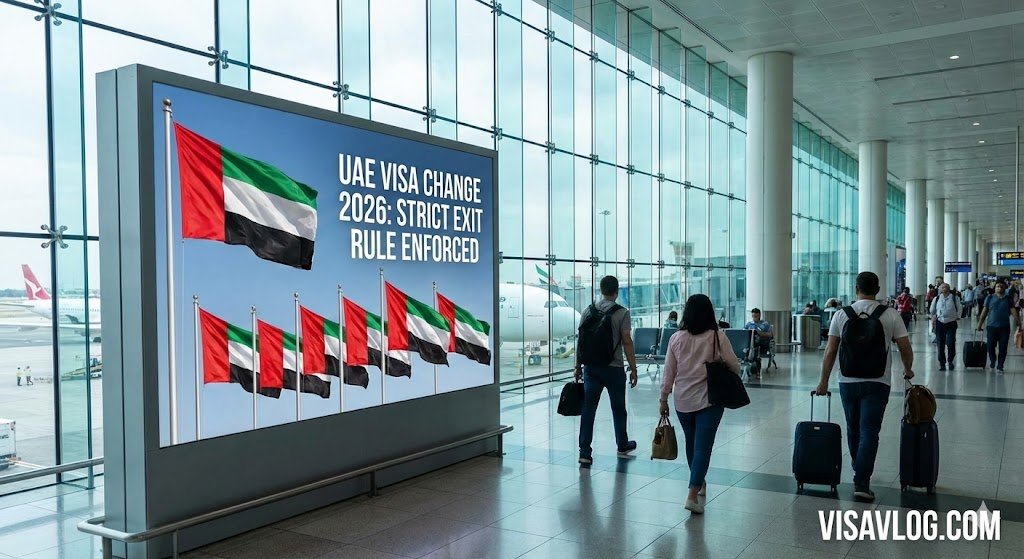

As the Dec 31, 2025 Amnesty deadline passes, UAE immigration strictly enforces the “Exit” rule for Visit-to-Work visa transfers. Learn why in-country status change is stopped, the reasons behind it, and how the A2A process works for 2026.
The era of “easy visa runs” from the comfort of your Dubai apartment is officially over. As we step into January 2026, the United Arab Emirates (UAE) has implemented one of the strictest enforcement campaigns in its immigration history. The “loophole” that allowed tourists to convert their Visit Visas into Work Permits without leaving the country has been firmly closed.
For job seekers from India, Pakistan, and Bangladesh, this is the most critical update of the year. If you are currently in the UAE on a tourist visa hoping to find a job, you must understand that the rules of the game have changed. You can no longer pay a fee to “change status” inside the country. You must exit.
This comprehensive guide explains exactly what is happening, the three major reasons why the UAE government made this decision, and the step-by-step process you must now follow.
- Read More:
- Japan eVISA System: Full List of Eligible Countries, Rules for Pakistan, India, EU & USA (2026 Guide)
- Trump Expands Travel Ban to 39 Countries: The Complete List & Official Reasons
- Sweden Proposes Major Tightening of Family Immigration Rules: Income Requirements Set to Soar
- Sweden’s Radical 2027 Proposal: Revoking Permanent Residence for Asylum Seekers (Analysis)
The Trigger: The End of the 2025 Visa Amnesty
To understand why this is happening now, we must look at the timeline. The UAE government launched a massive “Visa Amnesty” program in late 2025, which was extended until December 31, 2025. This amnesty was a humanitarian gesture, allowing thousands of overstayers to either regularize their status or leave the country without fines.
However, the government made it clear: Once the Amnesty ends, zero tolerance begins. Starting January 1, 2026, the Federal Authority for Identity, Citizenship, Customs and Port Security (ICP) has reset the system. To ensure that the “slate is wiped clean,” they have disabled the “In-Country Status Change” option for Employment Visas. This forces every new worker to enter the country through the proper legal channel—as an employee, not a tourist.
The 3 Main Reasons Behind the Strict Enforcement
Many people are asking, “Why did they change a system that was working?” The decision is not random; it is based on data and security.
1. Stopping the “Tourist Worker” Phenomenon The UAE wants to separate “Tourism” from “Employment.” In recent years, millions of people entered on cheap 3-month tourist visas with no intention of sightseeing—they were purely looking for work. This clogged the tourism system. By forcing an exit, the government ensures that only genuine tourists apply for tourist visas, and workers enter on work entry permits.
2. Security and Biometric Updates The UAE is rolling out a new, advanced biometric security system for 2026. When you change your status “inside the country,” you often skip the rigorous airport security checks and retinal scans. By forcing you to “Exit and Re-enter,” the border security gets to scan you again, ensuring that no one with a criminal record or security ban slips through the system.
3. Economic Regulation (The “Overstay” Crisis) Statistics from 2024-2025 showed that over 15% of visitors on tourist visas ended up overstaying while looking for jobs. This created a massive burden of illegal residents. The new rule acts as a filter: if you cannot afford the flight to exit and re-enter, you likely cannot afford to live in the UAE without a job. It discourages low-income, unskilled labor from swarming the market without secured employment.
The New Process: Airport-to-Airport (A2A)
Since you can no longer change your visa while sitting in Dubai, you must use the A2A (Airport-to-Airport) method. This is now the standard procedure for 90% of South Asian applicants.
Step 1: Get the Job Offer You pass the interview, and the company issues your “Offer Letter.” You sign it.
Step 2: The Employment Entry Permit The company applies for your Entry Permit (Pink Paper). Wait for this approval before you fly. Do not leave without it.
Step 3: The “Visa Run” Flight You (or your company) book an A2A package. You will fly from Dubai/Sharjah to a nearby airport like Muscat (Oman), Bahrain, or Kuwait.
- Cost: AED 1,200 – AED 1,600 (includes flight + visa processing fee).
- Time: You land in the neighboring country and wait in the transit terminal. You do not exit the airport there. You wait for 4 to 8 hours until the UAE system updates your status to “Exited.”
Step 4: Re-entry Once the system says “Exited,” your company’s PRO sends you the new Employment Visa file (PDF) to your phone. You print it at the transit desk, board the return flight, and enter the UAE as a Resident.
Exceptions: Who is Safe?
Not everyone has to leave. The strict exit rule mostly applies to Visit Visa to Employment Visa transfers.
- Golden Visa Holders: If you are upgrading to a Golden Visa, you can usually do it in-country.
- Spouse/Family Visa: If a husband is sponsoring his wife, she often does not need to exit.
- Free Zone VIPs: Certain high-level professionals in TECOM or DIFC zones may still have “In-Country” options, but these cost significantly more (AED 2,000+ extra).
Financial Warning for Job Seekers
This new rule makes looking for a job in Dubai more expensive.
- Old Cost: Visit Visa + Food + Metro.
- New Cost: Visit Visa + Food + Metro + AED 1,500 Exit Flight.
Advice: Before you accept a job, clarify with the HR manager: “Who pays for the status change flight?” Under UAE Labor Law, the employer should pay, but many smaller companies try to force the employee to pay. Be ready for this negotiation.