
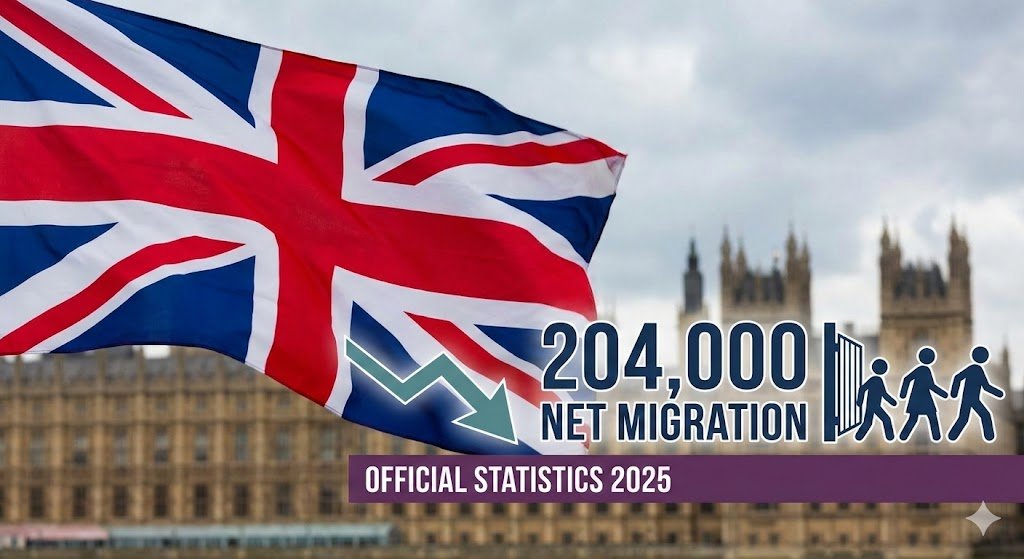

London, UK – The Office for National Statistics (ONS) has released its latest provisional figures for long-term international migration, revealing a sharp decline in net migration to the United Kingdom. According to the data published on November 27, 2025, net migration for the year ending June 2025 is estimated at 204,000, a significant drop from the 649,000 recorded in the previous year.
This substantial decrease aligns with the government’s ongoing efforts to curb immigration numbers through tighter visa restrictions and reforms. The following breakdown analyses the official statistics and government policy shifts driving this trend.
Sharp Decline in Overall Numbers
The Long-term international migration, provisional: year ending June 2025 bulletin indicates that the fall in net migration is primarily driven by a decrease in non-EU nationals arriving for work and study, alongside a gradual increase in emigration.
The figure of 204,000 represents a level similar to that seen before the post-Brexit immigration system was fully implemented. The ONS highlights that while immigration remains the main driver of population change, the gap between arrivals and departures has narrowed significantly.
Drivers of the Drop: Visa Restrictions Take Effect
A major factor in this decline is the reduction in dependents accompanying visa holders. The ONS data shows a drop of approximately 70% in the number of dependents arriving on work and study visas. This follows policy changes that restricted international students and care workers from bringing family members to the UK.
In a detailed analysis, the ONS published a blog post titled What is driving the current fall in net migration?, which explains that non-EU immigration has decreased by 37% (394,000 people) compared to the previous year. Simultaneously, emigration has risen, particularly among former students returning to their home countries.
Government Response and New Settlement Policies
The release of these figures comes shortly after the Home Office outlined further reforms intended to manage migration. On November 20, 2025, the government published a statement titled A fairer pathway to settlement, delivered by The Rt Hon Shabana Mahmood MP.
In this statement, the government emphasized that the previous pace of migration had been “destabilising” and outlined a new “earned settlement” model. This model proposes that migrants must be lawfully resident in the UK for a longer period—potentially up to 10 years—before qualifying for indefinite leave to remain, ensuring a sustained economic contribution.
- Read more:-
- Who is Shabana Mahmood ? A complete Biography.
- Restoring Order: The UK’s New Migration Strategy
- The UK Home Office’s New Asylum Model: immigration reforms
- Asylum seekers to face 20-year wait for UK settlement under new laws
- The UK Visitor Visa: A Comprehensive Guide.
- A Detailed Guide to the UK’s Electronic Travel Authorisation (ETA)
EU and British Nationals
The official statistics also highlight trends among EU and British nationals. Net migration for EU nationals is provisionally estimated at negative 70,000, meaning more EU citizens are leaving the UK than arriving. Similarly, British nationals saw a negative net migration of 109,000.
For a comprehensive view of the methodology and data sources, the ONS has provided the Admin-based long-term international migration estimates QMI, which details the shift towards using administrative data from the Home Office and Department for Work and Pensions rather than relying solely on passenger surveys.
Future Population Estimates
These migration figures feed directly into the wider population estimates. The ONS simultaneously released the Provisional population estimate for the UK: mid-2025, which places the UK population at approximately 69.5 million. This estimate underscores the role of migration as a key component of population change, even as the rate of growth slows.



