
The year 2025 ushered in a period of intense scrutiny and policy upheaval in the UK Student Visa system, profoundly affecting prospective students from South Asia, particularly Pakistan and Bangladesh. While no official government policy was announced to “block” students from these nations, the combined effect of tightened regulations and updated compliance criteria has led to a major institutional slowdown, causing significant difficulty for thousands of genuine applicants. Indian students, despite remaining the largest cohort, also felt the impact of universally applied restrictions on dependents.
This column examines the root causes of this crisis, presents specific official data from the year ending September 2025, and outlines the prospects for applicants from the Indian subcontinent in 2026.
A. The Crisis Trigger: Compliance and Refusal Rates in 2025
The core reason for the institutional “freeze” on recruitment from Pakistan and Bangladesh is not a targeted block by the UK Home Office but rather a defensive manoeuvre by UK universities seeking to maintain their Student Sponsor Licence.
The Basic Compliance Assessment (BCA) Overhaul
- The Change: A critical regulatory overhaul took place in 2025 that tightened the Basic Compliance Assessment (BCA) framework. Previously, institutions risked sanctions if their sponsored visa applications had a refusal rate exceeding 10%.
- The New Rule: The updated BCA rules reduced the maximum allowable refusal rate for a sponsoring institution to just 5%. If a university’s visa refusal rate exceeds this 5% threshold, it risks losing its ability to enroll international students altogether. This measure aims to reduce overall net migration and curb visa misuse.
- Official Source: The criteria for sponsorship and compliance are continuously governed by the Home Office’s Student Sponsor Guidance, which underpins these regulatory changes.
- Read more:-
- UK Asylum Overhaul: New Fast-Track Rejections & Safe Country List
- UK Immigration Update: Home Office Releases New Migration Data (Dec 1)
- UK Skilled Worker Visa 2025: New Salary Rules
- How to Switch from Student Visa to Skilled Worker Visa in UK
Refusal Rate Disparity (Year Ending September 2025 Data)
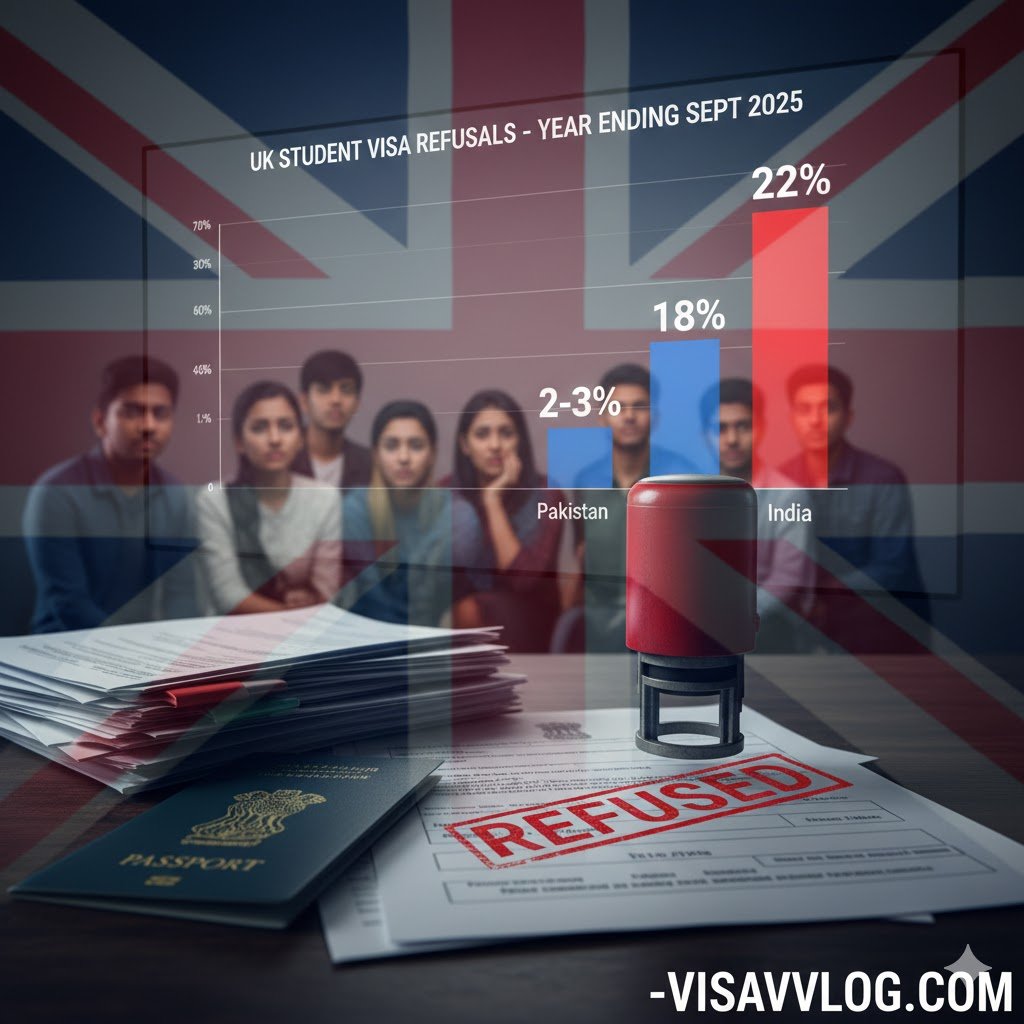
Official data from the Home Office reveals that the refusal rates for Pakistan and Bangladesh far exceeded the new 5% compliance threshold, forcing universities to scale back recruitment:
| Nationality | Main Applicant Visas Granted (Year Ending June 2025) | Refusal Rate (Year Ending Sept 2025) | Impact on Universities |
| India | 98,014 | ~2-3% (Low) | Minimal risk, but affected by dependant restrictions. |
| Pakistan | 37,013 | ~18% (High) | Significant risk; multiple universities halted recruitment. |
| Bangladesh | N/A (Top 20) | ~22% (Very High) | Extreme risk; some universities stopped recruitment entirely. |
Note: While India’s refusal rate remains low, Pakistani and Bangladeshi applicants together accounted for nearly half of the 23,036 total student visa refusals recorded by the Home Office in the year to September 2025. This high volume of refusals placed the most significant strain on the university compliance system.
B. Universal Policy Changes Affecting All South Asian Students
The tightening visa landscape for students in 2025 was driven by two key, universal policies that indirectly created higher barriers for applicants from high-volume markets, including India, Pakistan, and Bangladesh.
1. The Dependent Restriction Policy
- The Change: Effective January 2025, the UK government removed the right for most international students (those pursuing courses below PhD level) to bring family members (dependents) with them.
- Impact on India: While India maintained the top spot for main applicant visas granted (98,014 in the year ending June 2025), the total number of Indian students saw a decrease of 11%, primarily due to the sharp decline in accompanying dependents. This policy instantly affected thousands of potential applicants seeking to relocate with their families.
2. Heightened Financial Scrutiny (The Genuine Student Test)
The financial evidence requirement received intense scrutiny in 2025, leading to increased rejection rates based on authenticity concerns.
- The Requirement: All applicants must show they have enough money to cover their first year’s tuition and living expenses (e.g., £1,334/month for London, capped at 9 months). Full details are on the Student visa: Money you need page.
- The Problem: The Home Office intensified its checks on the source and stability of these funds. Applications were rejected under the Genuine Student (GS) requirement if funds were suspected of being “parked” (deposited briefly to meet the 28-day holding requirement). This scrutiny disproportionately affected markets where applicants rely on complex funding mechanisms or sudden loans, leading to the high refusal rates observed in Pakistan and Bangladesh. Furthermore, some universities raised deposit requirements to the full tuition fee upfront as a defensive measure to verify financial commitment, causing immediate hardship for genuine students.
C. The Outlook for 2026 and Official Guidance
The situation in 2026 is predicted to remain challenging, defined by institutional risk aversion and continued regulatory strictness.
Institutional Response and 2026 Forecast
- Recruitment Freeze: Several universities (including the University of Chester and University of Hertfordshire) have suspended recruitment from Pakistan and Bangladesh until autumn 2026 to clean up their compliance records.
- Tighter Vetting: Institutions are increasing pre-CAS interviews, demanding higher deposits, and implementing stricter documentation checks to ensure they only sponsor applicants with a high probability of success, a trend that will define recruitment throughout 2026.
- Government Stance: The government maintains that these measures are essential to “protect the integrity” of the student route and ensure it is not used as a “backdoor to settlement,” which will continue to be the primary driver of policy.
Official Guidance for 2026 Applicants
Applicants from India, Pakistan, and Bangladesh must focus on presenting an unimpeachable application, using official resources:
| Requirement Focus | Official Government URL Source |
| Visa Application Overview | GOV.UK Student Visa: Overview |
| Financial Evidence (Crucial) | GOV.UK Student Visa: Money you need |
| Dependent Restriction Details | GOV.UK News: UK government tightens student visa rules |
In conclusion, the difficulties faced by students from the Indian subcontinent are not a result of a discriminatory block but rather the unavoidable consequence of the UK Home Office’s decision to drastically lower the visa refusal tolerance for sponsoring institutions. 2026 will be a year where only the most meticulously prepared and financially stable applicants will succeed, as universities prioritize regulatory compliance over high-volume enrollment.