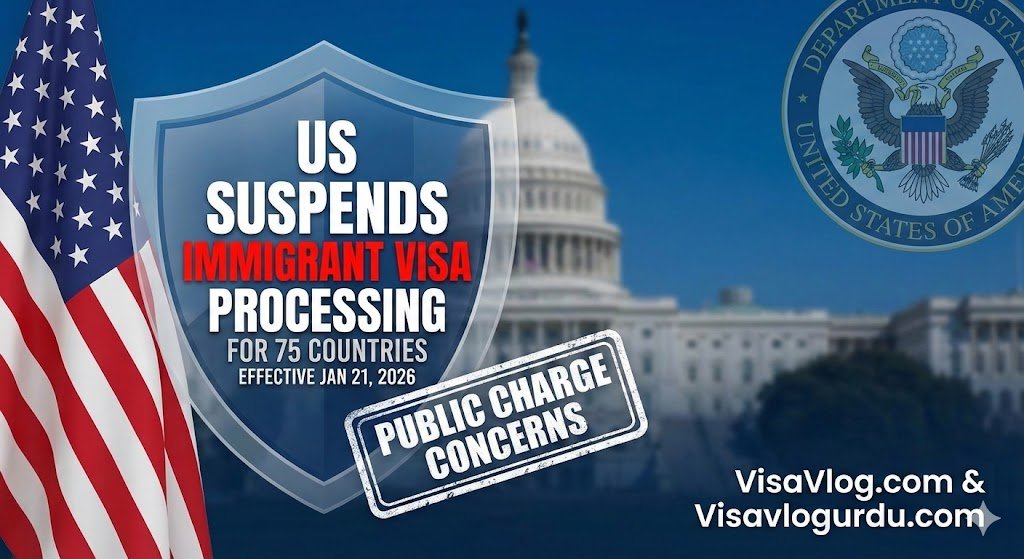

The US State Department will suspend immigrant visa processing for 75 countries, including Pakistan and Bangladesh, from January 21, 2026. This suspension aims to reassess screening for “public charge” concerns.
The United States Department of State has officially announced a sweeping suspension of immigrant visa processing for citizens of 75 countries, effective January 21, 2026. This directive, issued under the guidance of the Secretary of State, marks a significant shift in U.S. immigration policy, focusing on the “public charge” ground of inadmissibility. The primary objective is to reassess vetting procedures to ensure that incoming permanent residents are financially self-sufficient and do not rely on public assistance programs. While this pause significantly impacts those seeking green cards and permanent residency, the State Department has clarified that non-immigrant visas—such as tourist (B1/B2), student (F1), and temporary work visas—will continue to be processed, albeit under stricter scrutiny.
The Public Charge Rule and the Reassessment Period The legal foundation for this decision lies in the long-standing “public charge” provision of the Immigration and Nationality Act (INA). According to official statements from the U.S. Department of State (travel.state.gov), the administration is concerned that a high percentage of immigrants from specific nations may become dependent on government-funded benefits like Medicaid, food assistance (SNAP), or housing vouchers. By pausing the issuance of immigrant visas, the government intends to implement a more robust screening framework. This framework will evaluate an applicant’s age, health, family status, assets, resources, financial status, and education or skills to predict the likelihood of them becoming a public charge in the future.
- Read More
- Canada Immigration 2026: Major Changes to Study Permits and PR Targets
- UK Skilled Worker Visa Update 2026: Mandatory B2 English Requirement
- Trump Expands Travel Ban to 39 Countries: The Complete Official List
- Italy New Immigration 2026: 150,000 Work Visas Announced
- Saudi Arabia Leads Global List for Deporting Foreign Workers in 2025
Affected Countries and Global Impact The list of 75 affected nations spans nearly every continent, including major sources of immigration. Notable countries on the list include Pakistan, Bangladesh, Afghanistan, Russia, Iran, Somalia, Nigeria, Brazil, Thailand, and Egypt. The suspension is indefinite, meaning it will remain in place until the Department of State and the Department of Homeland Security (DHS) finalize their review of screening protocols. For applicants in these countries, this means that even if they have already attended an interview or have an upcoming appointment, a final visa will not be issued until the pause is lifted.
Operational Details for Applicants US embassies and consulates in the 75 countries have been instructed to continue scheduling interviews where possible, but to hold the final adjudication of the cases. According to USCIS (uscis.gov), this move is part of a broader “America First” strategy to protect taxpayer resources. Applicants are advised to keep their financial documentation updated, as the new vetting standards are expected to require more comprehensive proof of financial independence or the presence of a strong, legally binding Affidavit of Support from a U.S. sponsor.
Exceptions and Non-Immigrant Visas It is crucial for travelers to understand what this policy does not cover. As stated by the State Department, the suspension does not apply to non-immigrant visas. This is particularly important for the upcoming global events, such as the 2026 FIFA World Cup. Travelers from the affected countries can still apply for visitor visas for business or pleasure. Furthermore, dual nationals who hold a passport from a country not on the 75-country list are exempt from the suspension, provided they apply using their non-listed passport.
The 2026 World Cup and Non-Immigrant Travel Despite the severity of the immigrant visa suspension, the U.S. government has emphasized its commitment to global events. The 2026 FIFA World Cup, which the U.S. is co-hosting, will proceed with standard non-immigrant visa protocols. Travelers from the 75 affected countries can still apply for visitor visas. However, they are advised to apply early due to the anticipated surge in demand and the already strained resources at many overseas consulates.
Recommendations for Affected Families Families seeking reunification through I-130 petitions should remain patient. While the “processing” is paused, the underlying petitions can still be filed and approved by USCIS. The delay occurs at the final stage—the consular interview and visa issuance. Applicants should use this time to gather extensive financial records, including tax returns and proof of assets, to demonstrate that they will not require public assistance.
Summary of Affected Nations The full list includes: Afghanistan, Albania, Algeria, Antigua and Barbuda, Armenia, Azerbaijan, Bahamas, Bangladesh, Barbados, Belarus, Belize, Bhutan, Bosnia and Herzegovina, Brazil, Burma, Cambodia, Cameroon, Cape Verde, Colombia, Cote d’Ivoire, Cuba, Democratic Republic of the Congo, Dominica, Egypt, Eritrea, Ethiopia, Fiji, The Gambia, Georgia, Ghana, Grenada, Guatemala, Guinea, Haiti, Iran, Iraq, Jamaica, Jordan, Kazakhstan, Kosovo, Kuwait, Kyrgyz Republic, Laos, Lebanon, Liberia, Libya, Moldova, Mongolia, Montenegro, Morocco, Nepal, Nicaragua, Nigeria, North Macedonia, Pakistan, Republic of the Congo, Russia, Rwanda, Saint Kitts and Nevis, Saint Lucia, Saint Vincent and the Grenadines, Senegal, Sierra Leone, Somalia, South Sudan, Sudan, Syria, Tanzania, Thailand, Togo, Tunisia, Uganda, Uruguay, Uzbekistan, and Yemen.
Frequently Asked Questions (US Visa Suspension)
The U.S. State Department is pausing immigrant visa issuance to reassess screening protocols for applicants who might become a “public charge.” This measure ensures that incoming permanent residents are financially self-sufficient and do not rely on U.S. government assistance programs like Medicaid or SNAP. The suspension allows the government to implement stricter vetting standards to protect taxpayer resources.
The suspension is officially scheduled to take effect on January 21, 2026, for all 75 listed countries. It is currently categorized as an “indefinite” pause, meaning there is no fixed end date at this time. The freeze will remain active until the State Department and Department of Homeland Security finalize their review of the new screening procedures.
No, this specific suspension only applies to immigrant visas, which are for individuals seeking permanent residency in the United States. Non-immigrant categories, such as B1/B2 tourist visas, F1 student visas, and H-1B temporary work visas, will continue to be processed. However, applicants should expect more rigorous financial screening during their standard interviews due to the new public charge focus.
Foreign nationals who hold a valid, unexpired immigrant visa as of January 21, 2026, are generally not subject to this new suspension. The State Department has clarified that visas issued before the effective date have not been revoked under this specific guidance. However, travelers should always double-check their visa status with official government portals before boarding their flight.
U.S. embassies and consulates may continue to schedule and conduct interviews for immigrant visa applicants from the affected nations. However, even if an applicant is found eligible during the interview, the final visa will not be issued until the suspension is officially lifted. This means your case will remain in an “administrative hold” or “pending” status after the interview stage.
Yes, certain exceptions exist, such as for dual nationals applying with a passport from a country that is not on the 75-country list. Additionally, cases involving the national interest of the United States or urgent humanitarian reasons may be considered for a waiver on a case-by-case basis. These waivers require specific approval from the Secretary of State or the Secretary of Homeland Security.
Yes, U.S. citizens and permanent residents can still file I-130 or I-140 petitions with USCIS for their relatives or employees. The suspension occurs at the “Consular Processing” stage, which is the final step where the visa is issued at an embassy abroad. Filing petitions now ensures you maintain your place in the queue for when the suspension is eventually removed.