
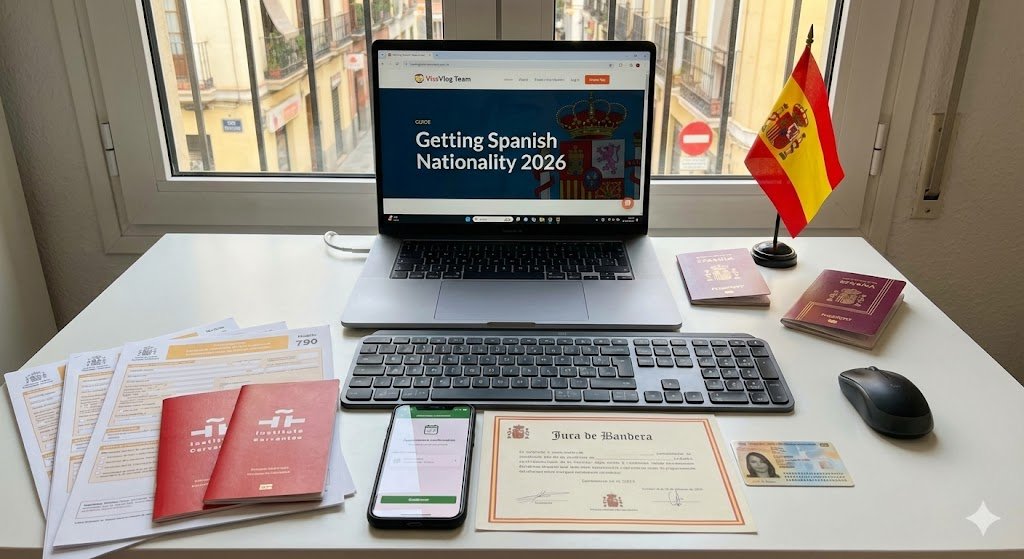

Current as of the 2025-2026 immigration cycle. Policies regarding fees, exam dates, and digital submission platforms are subject to government change. Always verify with the official links provided below before submitting an application.
For many, obtaining a Spanish passport is the ultimate goal of their immigration journey. It grants you the right to live and work anywhere in the European Union, offers one of the world’s most powerful travel documents, and provides the security of permanent status in a country known for its high quality of life.
However, the path to Nacionalidad Española por Residencia (Spanish Nationality by Residence) is a bureaucratic marathon, not a sprint. As we move into 2026, the Spanish Ministry of Justice has fully digitized the process, making it faster but also stricter regarding documentation accuracy.
This comprehensive, step-by-step guide will walk you through every phase of the process—from calculating your required residency time to taking the oath of allegiance.
Step 1: Determine Your Required Residency Timeline
The first and most critical step is knowing when you are eligible to apply. You cannot apply even one day early; your application will be instantly rejected.
The general rule is 10 years of residence, but Spain offers significant reductions for specific groups. You must have held a valid residence permit (not a student visa) for the entire duration of this time, continuously and immediately prior to your application.
The 10-Year General Rule
For most non-EU nationals (e.g., citizens of the USA, Canada, UK, India, China), you must reside legally in Spain for 10 continuous years.
- Read More:-
- Urgent Travel Alert: Canada Imposes Drastic Visa Crackdown on European Travelers
- U.S. Proposes Mandatory Passport for All New Diversity Visa Applicants
- Work Permit Exemptions in Sweden: Who Can Work Without One?
- Your Complete Guide to Getting a Swedish Residence Permit as a Self-Employed Entrepreneur
The 5-Year Refugee Rule
If you have officially obtained refugee status in Spain, your required timeline is reduced to 5 years. Note that this time starts counting from the date you applied for asylum, provided it was eventually granted.
The 2-Year “Ibero-American” Rule
This is the most famous exception. Nationals of Ibero-American countries (former Spanish colonies) and a few others can apply after just 2 years of legal residence.
- Eligible Countries: Mexico, Argentina, Colombia, Peru, Chile, Venezuela, Ecuador, Bolivia, Cuba, Dominican Republic, Costa Rica, El Salvador, Guatemala, Honduras, Nicaragua, Panama, Paraguay, Uruguay, and Brazil.
- Also Included: Nationals of Andorra, the Philippines, Equatorial Guinea, and Portugal.
- Sephardic Jews: Those who can prove Sephardic origin may also qualify under specific provisions, though the “Sephardic Law” has evolved.
The 1-Year Rule (Family & Birth)
This is the fastest pathway and applies to:
- Anyone born on Spanish soil.
- Anyone who has been legally married to a Spanish national for one year and is not separated (factually or legally).
- Anyone born outside Spain to a Spanish father or mother (or grandfather/grandmother), if they did not opt for nationality sooner.
- Widows/widowers of Spanish nationals (if they were not separated at the time of death).
Important Note on Student Visas: Time spent in Spain on a student visa (estancia) does not count toward these years. It only counts 50% towards permanent residency, but 0% towards nationality. You must be on a proper residence permit (work permit, non-lucrative visa, family reunification, etc.).
Step 2: Pass the Mandatory Exams (CCSE & DELE)
Unless you qualify for a specific waiver, you must pass two exams administered by the Instituto Cervantes. In 2026, these exams are fully digital in terms of registration and certification.
1. The CCSE Exam (Constitutional and Sociocultural Knowledge)
- Who must take it: Almost everyone over the age of 18.
- What it tests: Your knowledge of the Spanish Constitution, government structure, history, and culture.
- Format: 25 multiple-choice questions. You must get 15 correct (60%) to pass.
- Cost: Approximately €85 (subject to 2026 updates).
- Validity: The certificate is valid for 4 years.
- Official Registration: Instituto Cervantes – CCSE
2. The DELE A2 Exam (Spanish Language)
- Who must take it: Applicants from non-Spanish speaking countries.
- Exemption: Nationals of the Ibero-American countries listed in Step 1 are exempt from this test because Spanish is their mother tongue.
- Level Required: A2 (Basic) or higher.
- Format: Reading, writing, listening, and speaking.
- Cost: Varies by exam center, typically between €108 and €130.
- Validity: Indefinite (does not expire).
- Official Registration: Instituto Cervantes – DELE
Waivers: If you completed High School (ESO) or University in Spain, you may be exempt from both exams. Applicants over 70 or those who are illiterate can apply for a waiver (dispensa), though this requires a separate legal step.
Step 3: Gather Your Official Documents
In 2026, the Ministry of Justice is extremely strict about the validity of foreign documents. All foreign documents must be Apostilled (or legalized) and Translated into Spanish by a Sworn Translator (Traductor Jurado).
The Checklist:
- Full Passport: A scan of every single page of your current passport, including blank pages.
- NIE / TIE Card: Your current Foreigner Identity Card.
- Birth Certificate (Country of Origin): Must be issued recently (usually within the last 90 days), Apostilled, and Sworn Translated.
- Criminal Record Certificate (Country of Origin): Issued by the authorities of your home country (and any country where you lived in the last 5 years). This expires very quickly (usually 3 to 6 months), so order it last. Must be Apostilled and Sworn Translated.
- Marriage Certificate (If applicable): If applying under the 1-year marriage rule, you need your Spanish marriage certificate issued by the Spanish Civil Registry.
- Padrón Certificate: A “Volante de Empadronamiento” proving your current address in Spain. Available from your local Town Hall (Ayuntamiento).
- Exam Certificates: Digital codes for your PASS grade on the CCSE and DELE A2.
- Proof of Application Fee Payment: The “Tasas Modelo 790 Código 026”.
Official List of Translators: Ministry of Foreign Affairs – Sworn Translators
Step 4: Pay the Administrative Fee (Tasa 790-026)
Before you sit down to apply, you must pay the non-refundable government fee.
- Form: Modelo 790 Código 026.
- Cost: Approximately €104.05 (Verify the exact 2026 amount on the day of payment).
- How to Pay: You can pay this at any Spanish bank ATM or online via the Ministry gateway if you have a digital certificate.
Download the Fee Form Here: Sede Judicial – Tasa 790 026
Step 5: Submit Your Application Online
Paper applications are obsolete. In 2026, the only efficient way to apply is via the Sede Electrónica of the Ministry of Justice.
Prerequisite: You must have a Digital Certificate (Certificado Digital) or Cl@ve PIN installed on your browser. This allows you to sign documents legally online.
The Submission Process:
- Go to the official portal: Ministerio de Justicia – Solicitud de nacionalidad española por residencia.
- Identify yourself using your Digital Certificate.
- Fill in the detailed online form (personal data, residence history).
- Upload your documents: Ensure the PDFs are high quality and legible.
- Link your exams: There is a button to consent to the Ministry checking your CCSE/DELE scores automatically. Check this box to avoid uploading the certificates manually.
- Sign and Send: Once you click “Firmar y Enviar,” you will receive a receipt (Resguardo) with an “R” number (Número de Registro). Save this number. It is your lifeline to tracking your case.
Step 6: The Waiting Game & “Cómo Va Lo Mío”
How long does it take? In 2025-2026, thanks to the digitization “Shock Plan” (Plan de Choque), straightforward cases are being resolved in 4 to 12 months. However, complex cases can still take up to 2 years.
You can check your status anytime using the official tracker:
Official Tracker: Cómo va lo mío
Status Meanings:
- Abierto – En Tramitación: Your file is open and being worked on.
- Pendiente de solicitud de informes: The Ministry is asking the Police and CNI (Intelligence) to background check you.
- En Calificación: The final decision is being made.
- Concedido: Congratulations! You have been granted nationality.
Step 7: The Oath (La Jura de Bandera)
Once you receive the “Concedido” notification, the clock starts ticking. You have 180 days (6 months) to perform the Jura (Oath of Allegiance).
- Where: At your local Civil Registry (Registro Civil) or before a Notary (for a fee, usually faster).
- What happens: You swear loyalty to the King of Spain and obedience to the Constitution.
- Renunciation: Unless you are from an Ibero-American country (or France/Portugal in specific dual-citizen cases), you must formally declare that you renounce your previous nationality. Note: For many countries (like the US), this renunciation is only binding in Spanish eyes, not necessarily by your home country.
After the Jura, you will be issued your original Spanish Birth Certificate (Certificado de Nacimiento).
Step 8: Applying for Your DNI and Passport
With your new Spanish Birth Certificate in hand, you are technically a Spaniard. The final step is to get your documents.
- Book an appointment at the National Police station.
- Bring your Spanish Birth Certificate (marked “para DNI”).
- Bring a new passport-sized photo.
- Pay the fee (approx €12 for DNI, €30 for Passport).
- Walk out with your Spanish DNI and Red Passport.
2026 Evergreen Advice: The Importance of “Continuous” Residence
A common pitfall we see at VisaVlog Team involves the “Continuous Residence” requirement.
In 2026, immigration officers are strictly checking your absences.
- If applying for the 10-year track, you should not have been out of Spain for more than 6 consecutive months or 10 months total in the last 10 years.
- If applying for the 2-year track, stricter limits apply (usually no more than 3 months of absence total).
If you break this continuity, your clock resets to zero. Be meticulous with your travel history before you apply.
Good luck on your journey to becoming a Spanish citizen!